Selamat Pagi Malaysia, RTM, 1991.
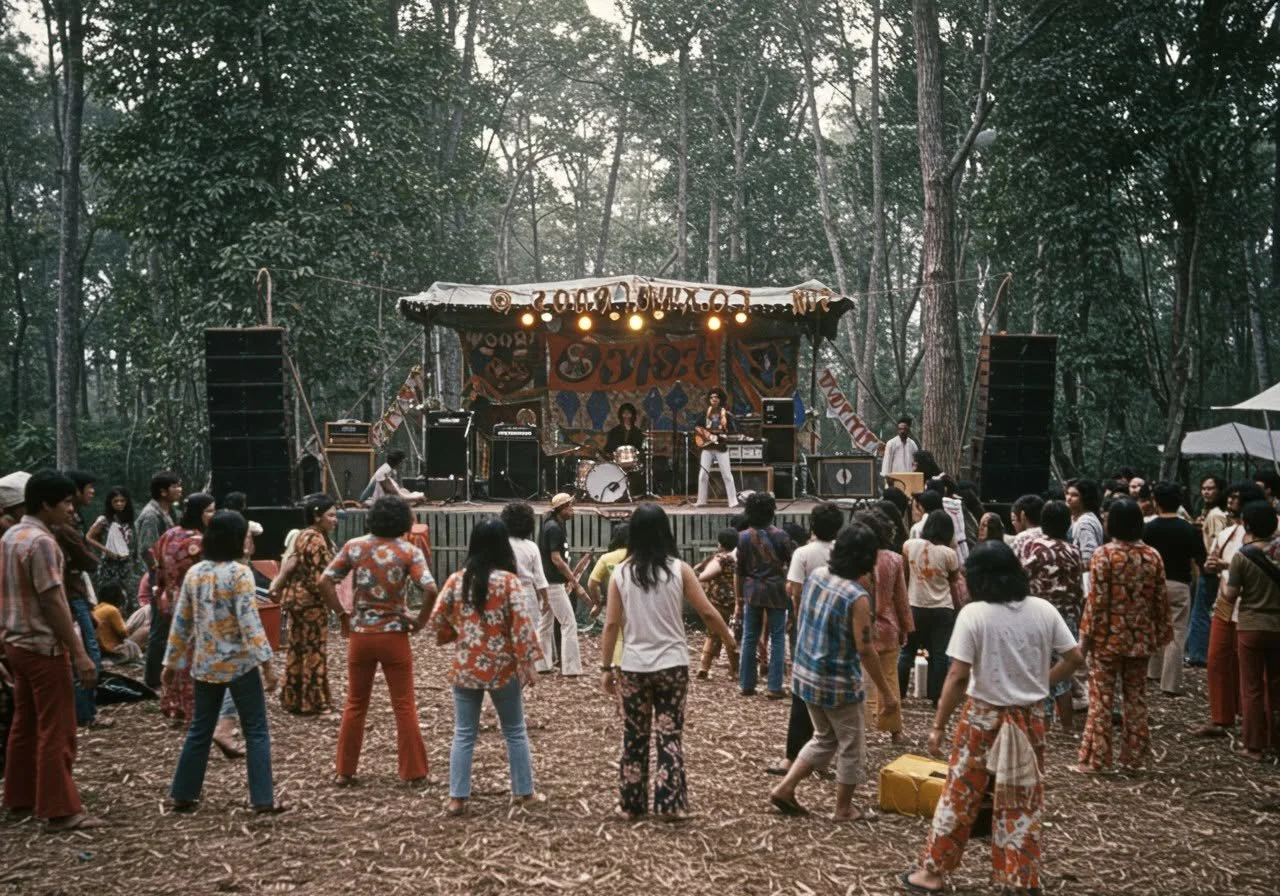
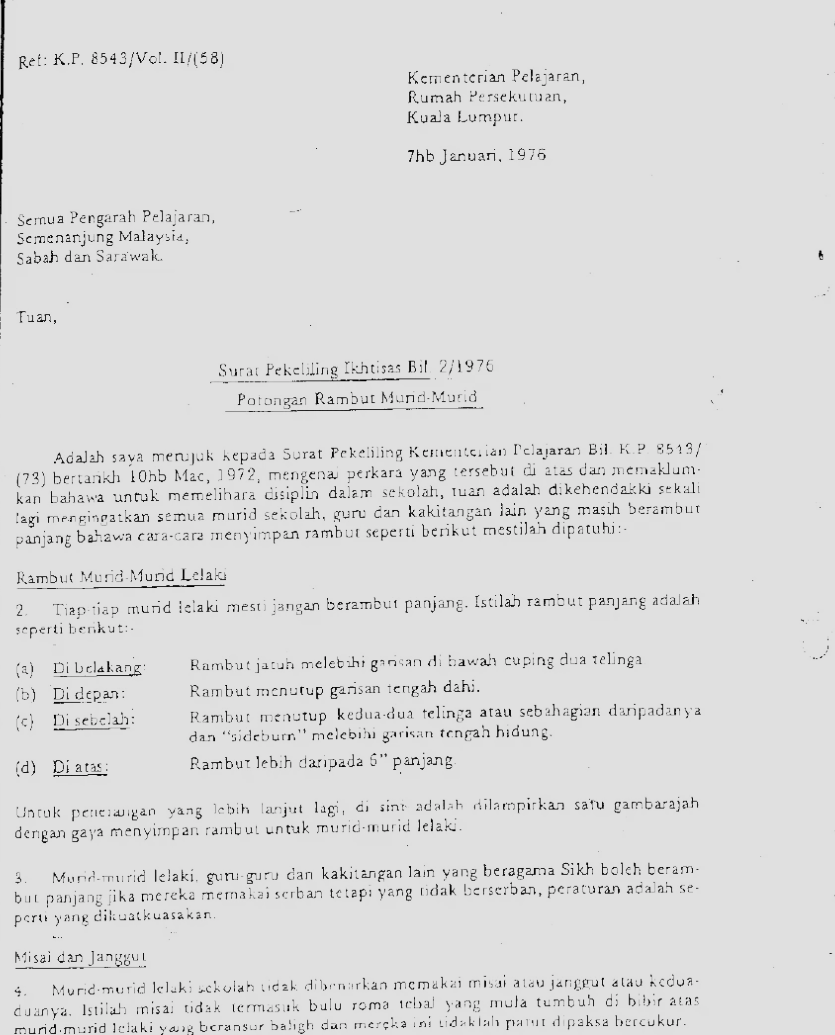
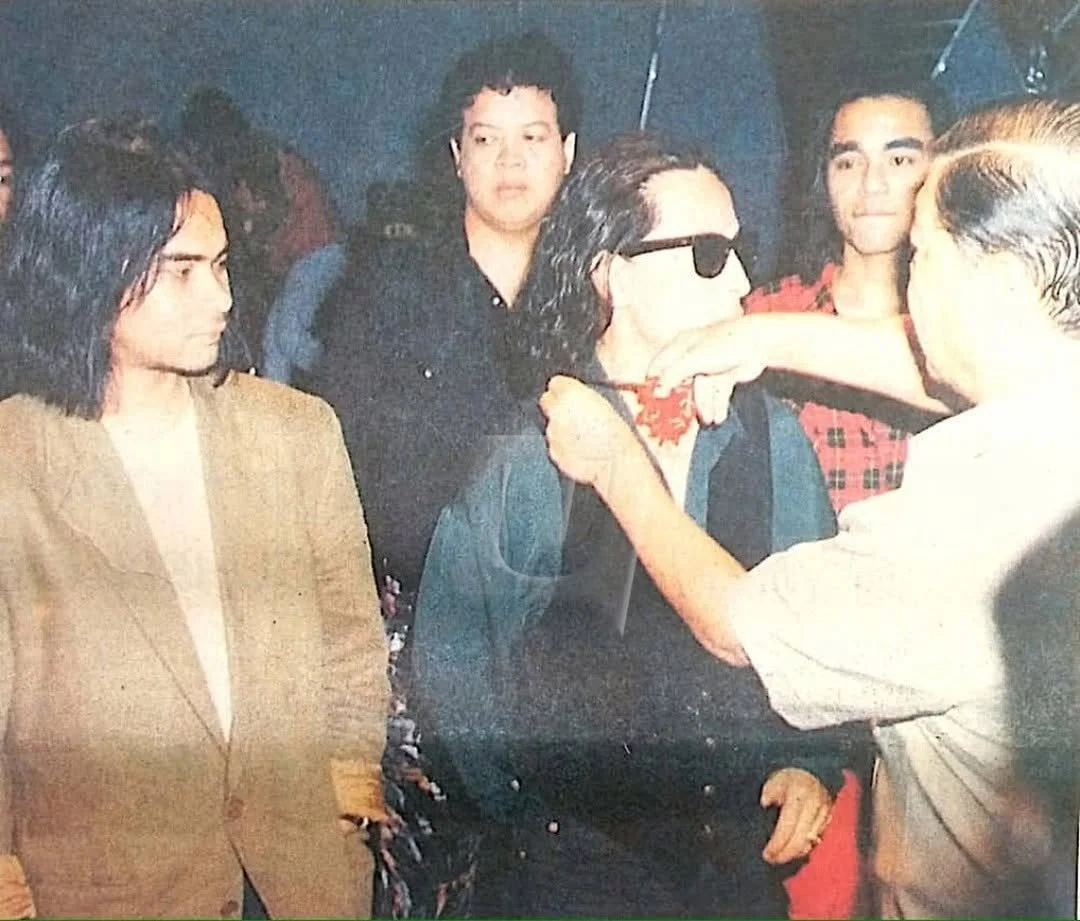
Two decades after Kem Semangat, the scissors of the state turned to rock music once again. In 1991, viewed as a negative social influence, any rock bands with long-haired members were prohibited from appearing on radio, television, and were banned from holding open air concerts. Amy of the band Search recalled: “…long-haired rockers had no chance. Only short-haired singers were given opportunities.” And so Amy and Awie of Wings, the two most prominent long-haired rock bands of the moment, submitted. Broadcast live on national television, the Minister of Information Mohamed Rahmat sheared off their long locks. It was the school haircut on the national stage.
In 2000, Umar Sharif was 12 years old. He had neglected to go to the barber on time, and so his hair had grown just past his nape, just past regulation, ever so slightly. He was walking along a corridor when a voice called out to him. A voice of authority, a teacher who he had not known, summoned him into a class that was not his. In front of this audience of strangers, the teacher examined his nape and ridiculed his mien with simple, callous words: “You want to be a girl, ah?”
He cut his hair.
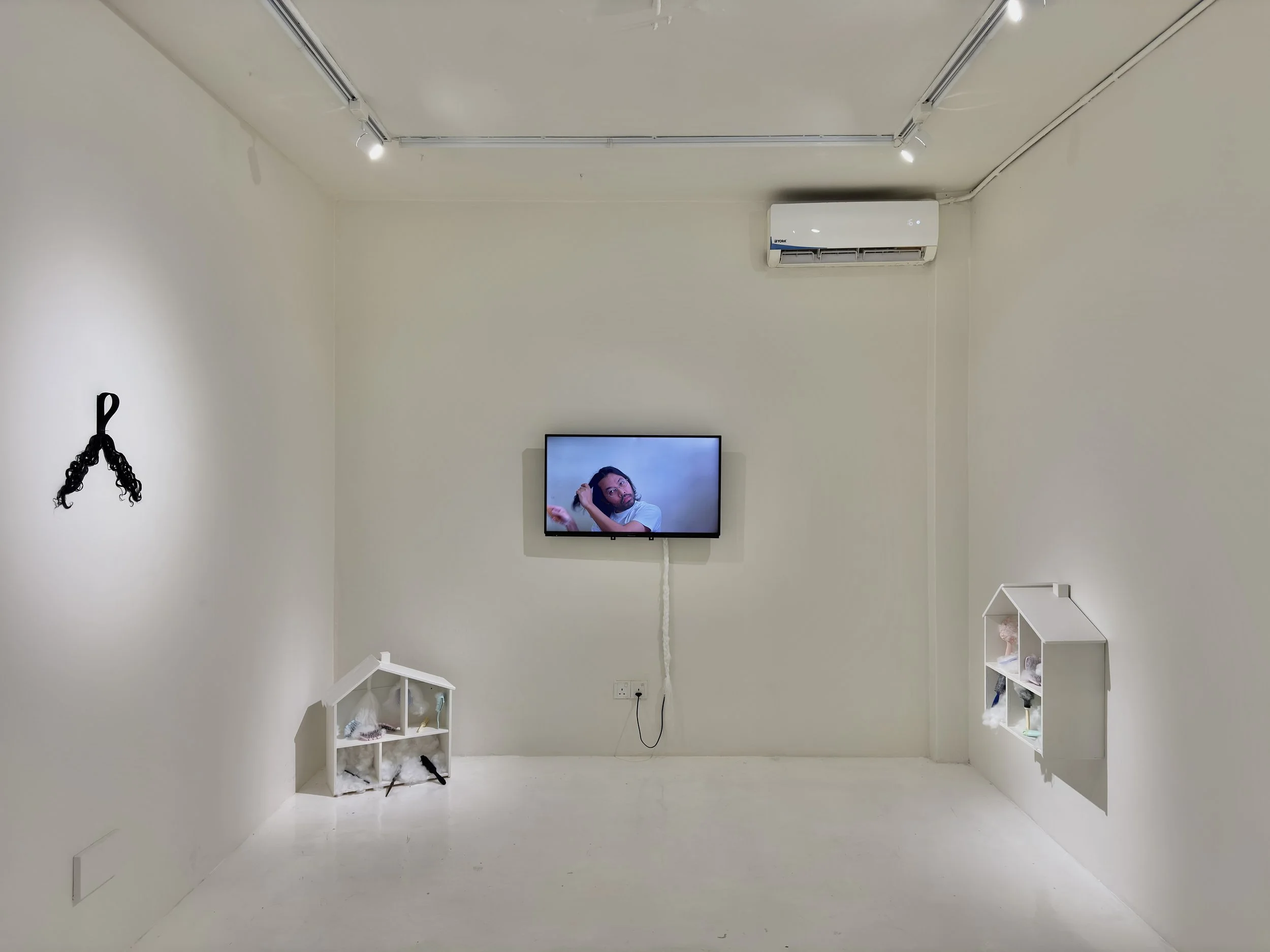
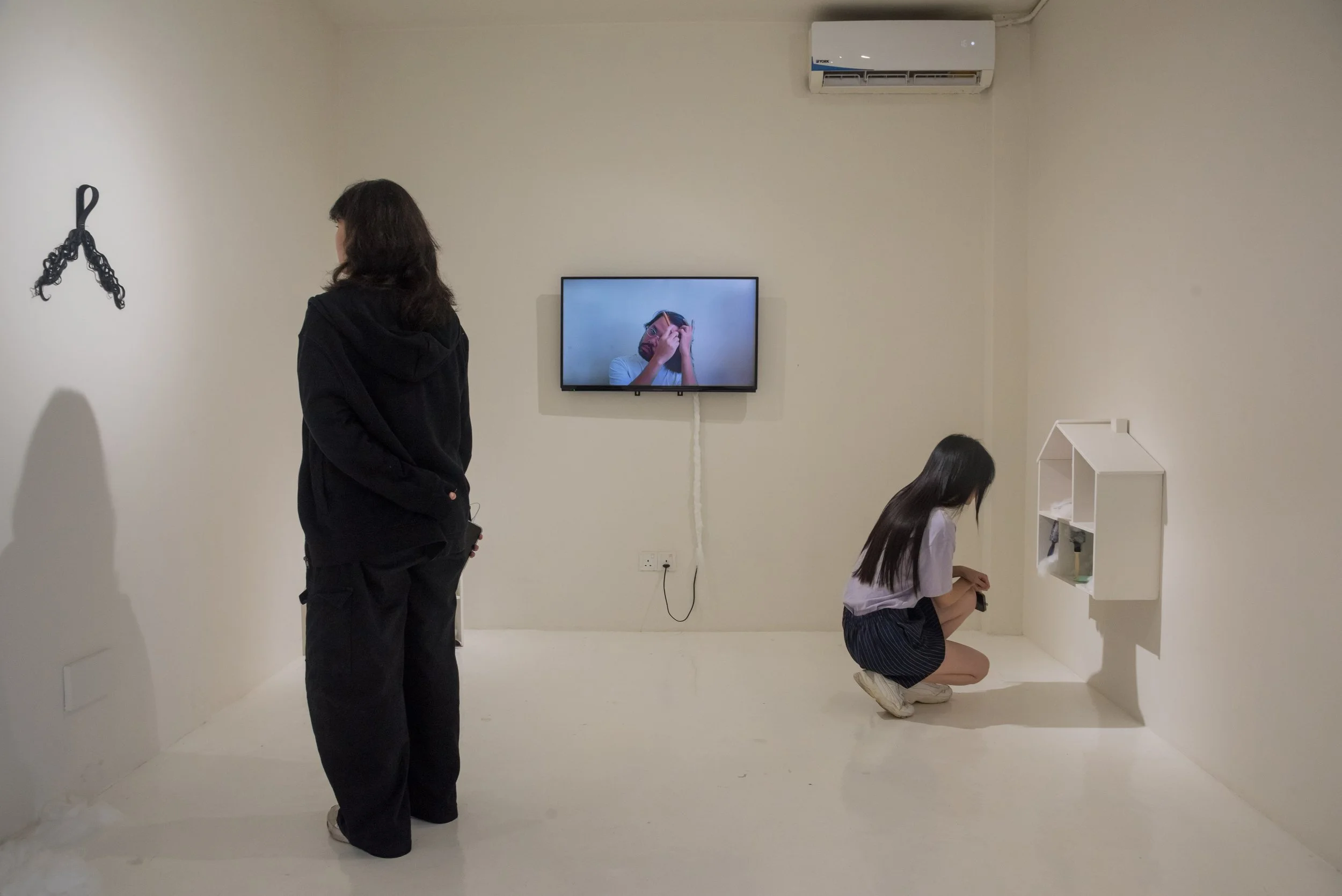
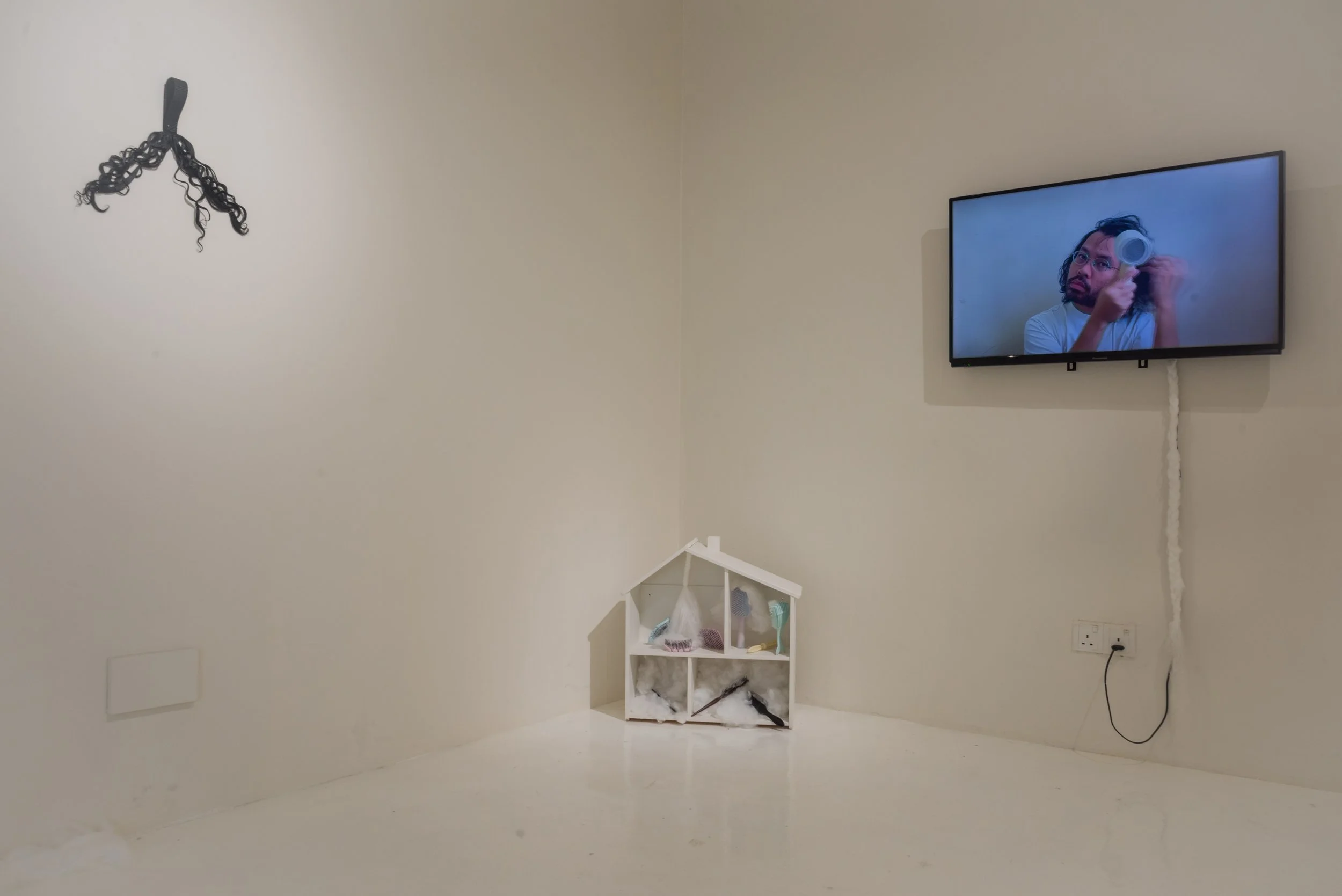
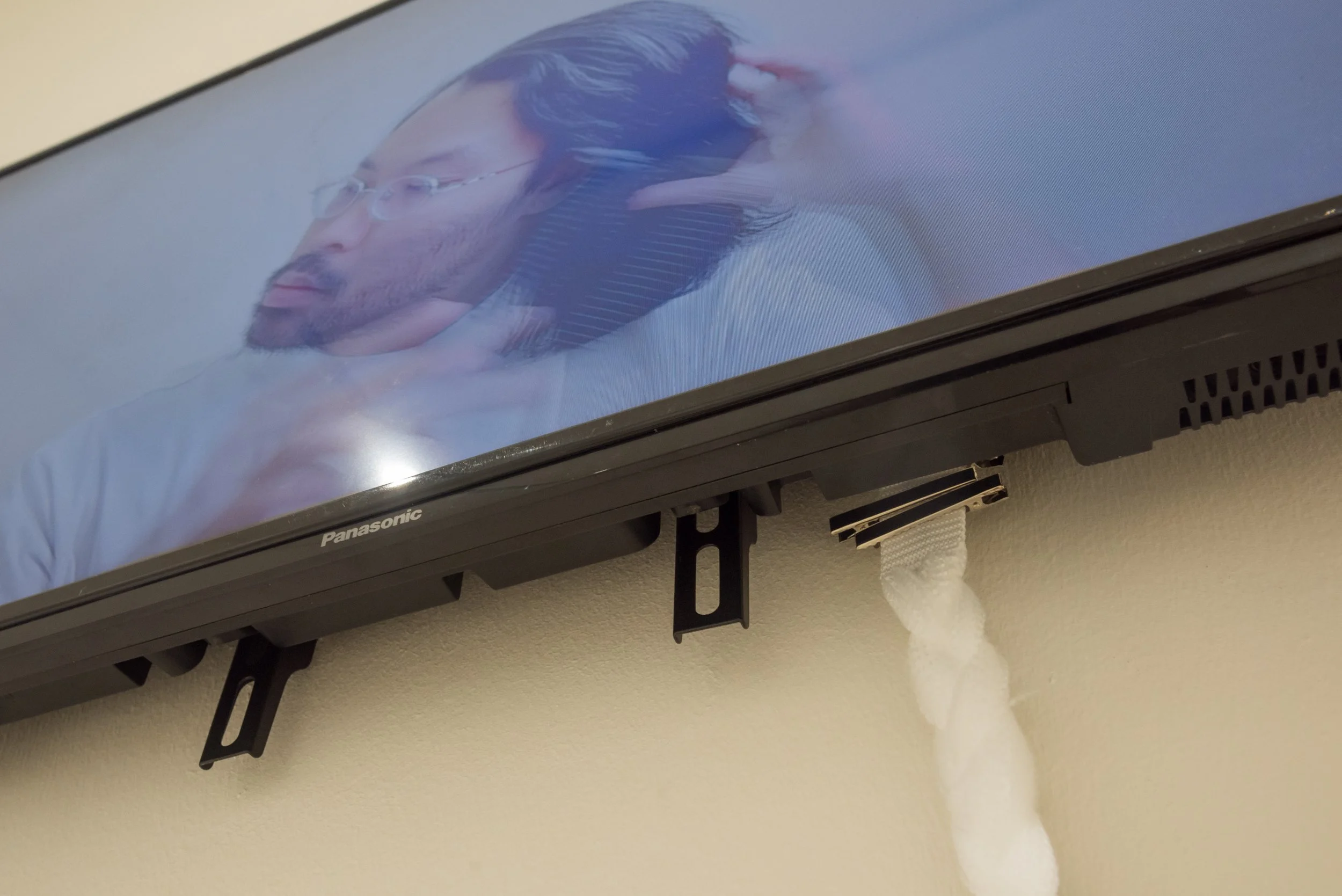
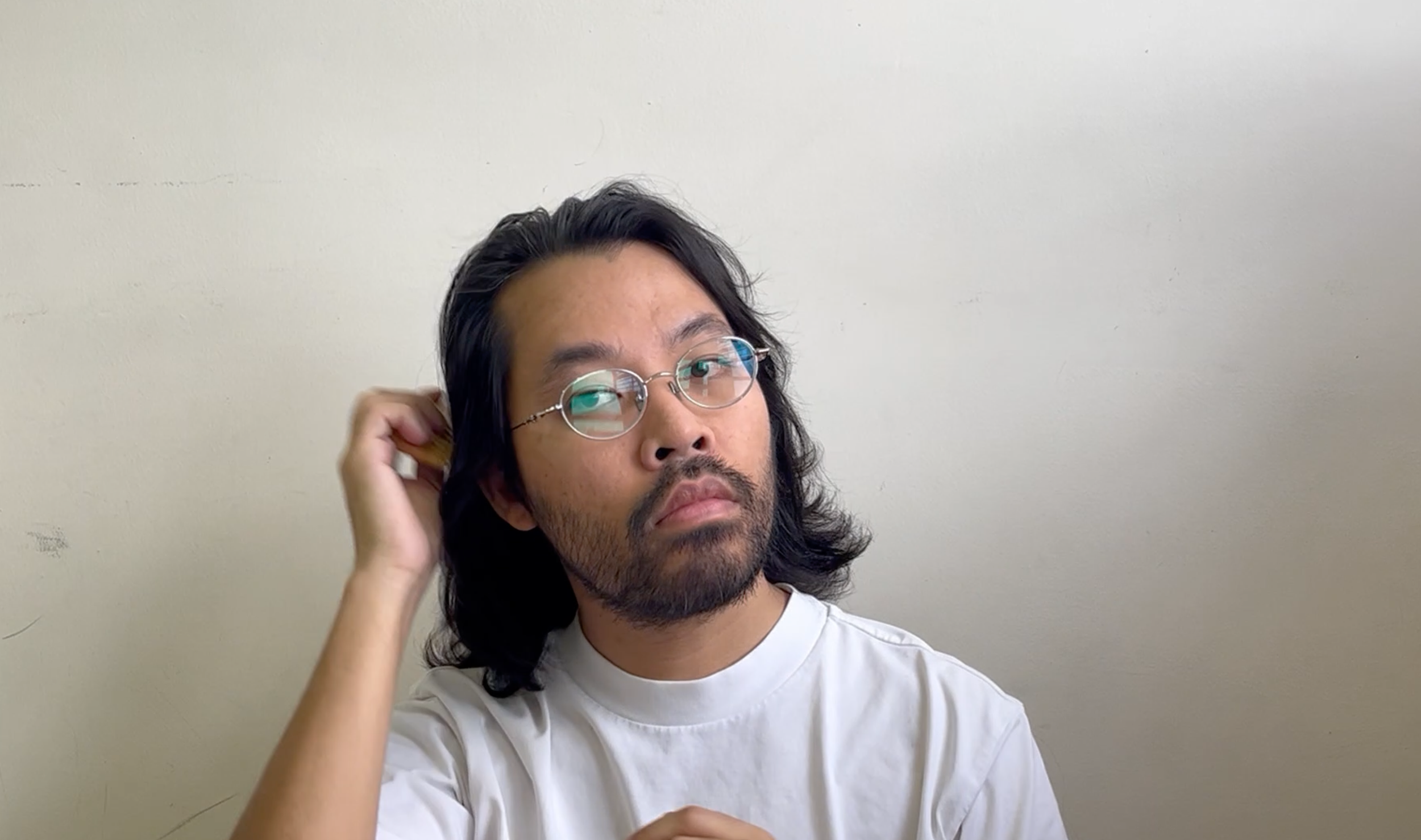
In 1000 Strokes (2026), Umar stages a different kind of televised grooming. Set against a stark white ground, he gazes into the camera, combing his own hair. He goes stroke by stroke, until he reaches one hundred, then changes the comb. Rinse and repeat until a thousand strokes. In Malaysian Chinese weddings, numbered strokes of the comb are a ritual of blessing. One stroke is for a lifelong marriage. The second, to grow old together. The third, to be blessed with many descendants. Malay wedding rites too have their own strokes of the comb, conferred by the mak andam, each stroke to trim in luck and to expel the unfortunate (buang sial). To comb is to groom one’s fate. The powers that be too hand down fates in strokes. The heaviest sentences arrive in strokes of the rotan, and schoolchildren too are caned in strokes; more often than not, the offence is filed under salah laku, misconduct; the more strokes, the more the body has strayed. Care and punishment share a unit of account.
Rambut Umar Banyak Ragam
For most of Umar’s childhood there was one default haircut. “You know lah, the typical haircut that you get from the mamak barber.” He was, he says, “quite fine” with that.
The first deviation came in Form 4 when Umar was 16 years old. Consider his options that year. One was to return to the standard issue, long prescribed “default”. The other, trending among his classmates, was to sport a gel-spiked crown, no doubt powered by copious amounts of Brylcreem hair gel. He despised it, “I thought it was a really dumb look. I’d rather go bald than do that kind of hair”. And so he did.
In a Malaysian school, going botak is a sign of punishment, cut by the disciplinarian’s scissors; to kena botak is for the authorities to descend upon you and inflict a visible mark of shame. Umar did it to himself, to the shock of his classmates who gathered around him when he appeared in school.
The shave was the first of many other ragam over the years.
First out of secondary school, there was the mandatory long-hair phase. “I feel like every Malay man has to go through this phase, no matter how alim they are later in life. It’s just a rite of passage.” Then at university, several variations of mohawk. “I thought I was in a cool school with cool kids, so I needed a cool cut.” In the last phase of university, Umar became enamoured with menswear. It was after all the era of Wak Doyok, of Augustman, GQ, Men’s Folio, of the dandy in the three-piece suit. He groomed himself smart, masculine, handsome.
Today, Umar wears the artist’s head: long, wavy, to the shoulder, with a well-trimmed beard. Umar still gets bored quickly. He is on a quixotic quest to find a style that is “infallible, effortless, and totally me”; one suspects this is a journey more than a destination.
In Purity and Danger (1966), anthropologist Mary Douglas argues that the body’s boundaries stand for the boundaries of societal systems, and it is by defining, policing, and ultimately purging that which violates it – bodily fluids, dirt, etc. – that order is created. Hair is, of course, an interesting thing. It grows out of the body of the person and once shed no longer the person. It is periodically cut and shorn, yet it regrows every day. Hair is, in theoretical terms, liminal. But there is a much older account of the same substance in Peninsular Malay belief. A person’s hair contains their semangat.
Semangat, in everyday parlance is spirit, morale. The older connotation carries metaphysical weight. Semangat is vital essence, and it is not limited to the human; a keris, a house, the first harvest of rice can all have semangat. To fall ill was to have your semangat stray or even be stolen; the bomoh’s job was its retrieval. And crucially, semangat pools in the body’s sheddings: nails, blood, sweat, saliva, and above all, hair. Thus hair could stand in for a person: woven into love magic to charm someone, kneaded into a dough effigy of a person to be cursed, or offered to the bomoh as payment, a surrender of part of oneself so that the whole can go free. To be tricked or to go bankrupt is kena cukur, to be shaved. To be punished is often to kena botak, to be balded. Entry into the community is a haircut too: the cukur jambul, the infant’s first locks shorn before the family and their weight given away in gold. In this language you are shaved into the world, shaved when you lose, shaved when you transgress.
In English’s parallel ledger, we call messy hair unruly, unkempt, unsightly, the words we reserve for undesirable subjects of rule. The act of mowing it is often synonymous with that of enrolment: the soldier’s induction, the monk’s initiation, the convict’s shave, the schoolboy’s crop.
To grow long hair then, is to stand apart, to break rank.
But apart into whose company? By several hadith, the Prophet Muhammad’s hair reached his earlobes or his shoulders. Syed Muhammad Naquib al-Attas was famed for his long mane. A. Samad Said’s white shock of hair and his long janggut made him a sort of patron sage of the BERSIH protests. Yet it is also the tresses of the drifter, the homeless, the drug addict. Prophet, professor, poet, punk, pariah: who is to say who?
Seragam
Perhaps it was only natural that faced with the idea that difference produced conflict that the country turned to the uniform. In June 1969, parliament stood suspended. The dead of the May 13 riots were still being counted. Into this silence, Education Minister Abdul Rahman bin Ya’kub announced a national school uniform, effective the following January. It was among the very first nationwide policies of the post-riot order, and the first to be implemented. Its explicit goal was to “minimize socioeconomic and ethnic distinctions visible through clothing”.
The iconic webbed school belt most Malaysians are familiar with seems to have come in later. Circulars in 1983 and 1985 explicitly specify the wearing of a belt, but simple in their prescription: “black or dark blue, no wider than about three centimetres, the buckle should be small and plain, and, “tanpa fesyen” (without fashion), and “tidak membahayakan” (not dangerous).
The idea of a waistband is not foreign to Malay custom. Consider the kain samping, the folded cloth worn over the trousers of the baju Melayu, and its myriad meanings: ikatan pancung for royalty, ikatan kembung for nobility, ikatan lingkup for the commoner. Worn long, below the knee, it marked a bachelor; up at the knee, a married man; tucked dagang dalam or displayed dagang luar, it placed the wearer west coast or east. Nor was the waist only a signboard. In the Hikayat Hang Tuah, the hero girds his kain cindai before the duel with Hang Jebat; in some tellings the cloth is inscribed with holy verses that turn blades. The bengkung, wound tight around a new mother through the forty-four days of confinement, pressed her body back into shape; its infant cousin, the tali barut, is also the figurative term for a turncoat, a spy. The waistband could protect, reform, and betray.
The webbing belt of regulation is a negation of such an inheritance. After all, it strives for something without fashion, without danger, which is to say without identity, and without the ability to resist. It is a chain where the kain samping was a sentence: the one restrains where the other spoke. The sole survivor of the belt’s function to distinguish is in the co-curriculars: the Scouts with the fleur-de-lis on the buckle, the Red Crescent with the white webbing and the crescent, the cadets with their unit crests and their ranks climbing the shoulder. The old language of Malay court hierarchy was nationalised into state-licensed denominations, into approved uniformed bodies, each taking its template from the military (drills, discipline, ranks, badges).
Add to this the fact that most belts are made of polypropylene, the material of the petro-state, of post-1974 Petronas. Malaysia’s first polypropylene factory, Titan’s plant at Pasir Gudang, came onstream in 1991. It is a material with no ethnic ancestry and no cultural memory, engineered to take whatever form the die assigns and to hold it; a design that strips the waist of speech and then licenses it to speak only in newly reformed bodies. The belt is the New Economic Policy, extruded, woven and buckled.
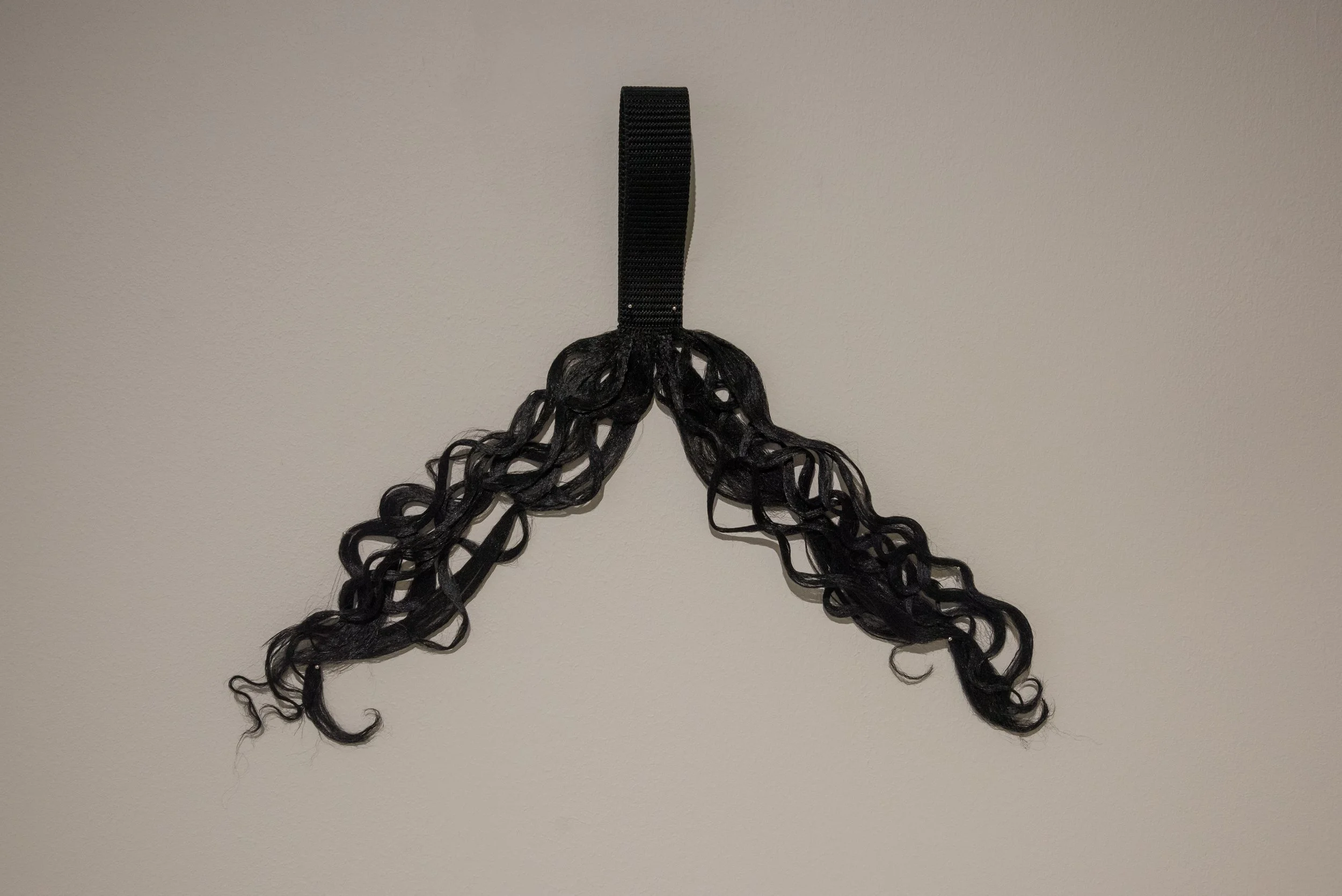
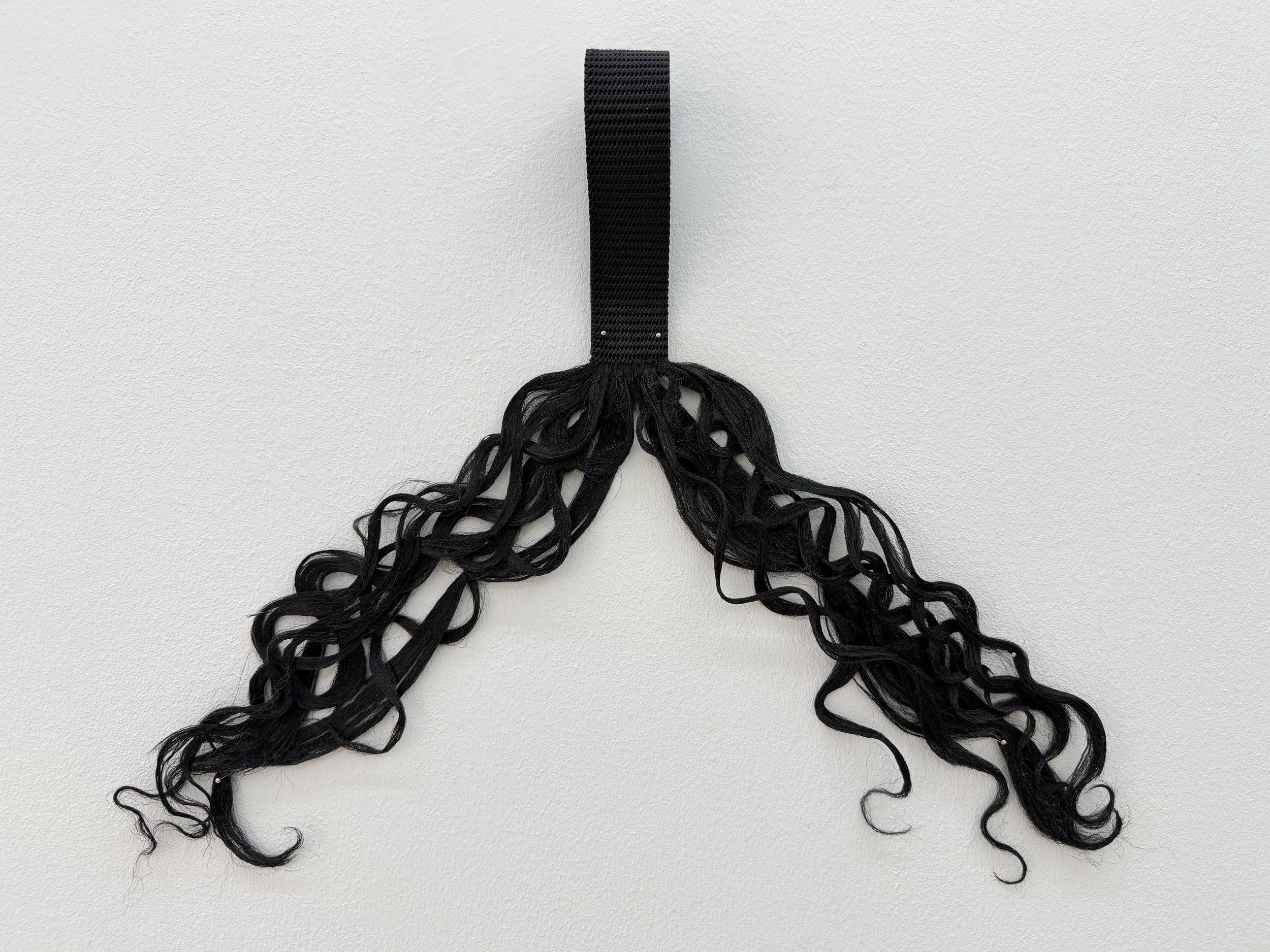
In Asuhan dan Dandanan (2025), Umar undoes the belt. Each component belt, lined up school-assembly style, begins straight and regulation exact. Then, at a certain point along their lengths, the tight webbing of sameness gives out and loosens into individual expression. Some are teased into great gothic volumes, others pressed flat and glossy; a few fall in ringlets, and then there is the odd extravagant updo. Each belt reveals itself as discrete strands all along, released from maximum custody. There is a lot of violence in the undoing. Polypropylene is tough; once moulded it keeps its shape and means to keep it, and Umar must wrench, soak and scorch it into changing its mind, unpicking the weave strand by strand, combing until the combs themselves snap. “Hair” is teased, stripped, relaxed, straightened, blown, tamed, shocked, ripped, distressed, clamped, pressed, whipped, blasted, disciplined; the catalogue of hair care runs close to the lexicons of violence and of sex.
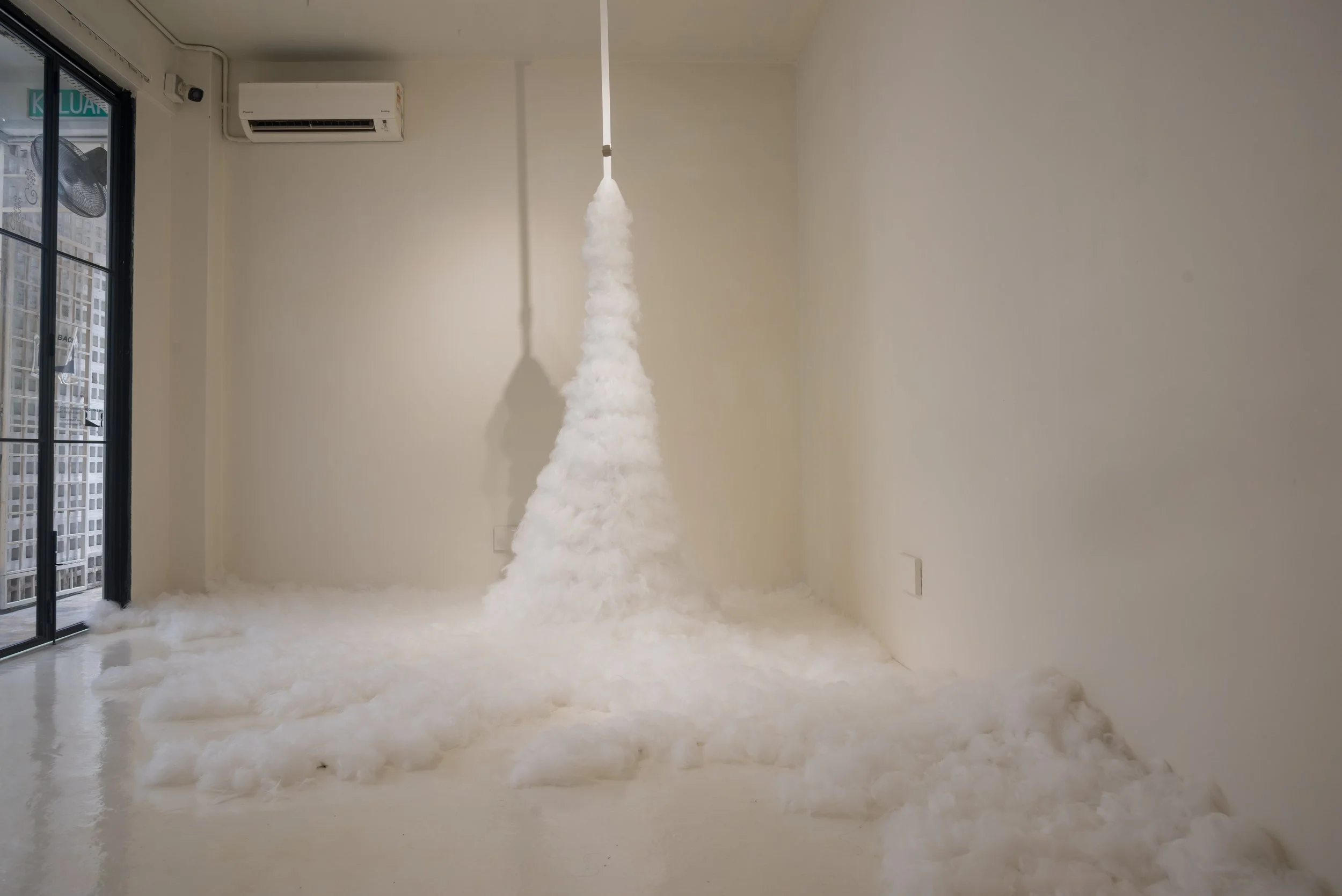
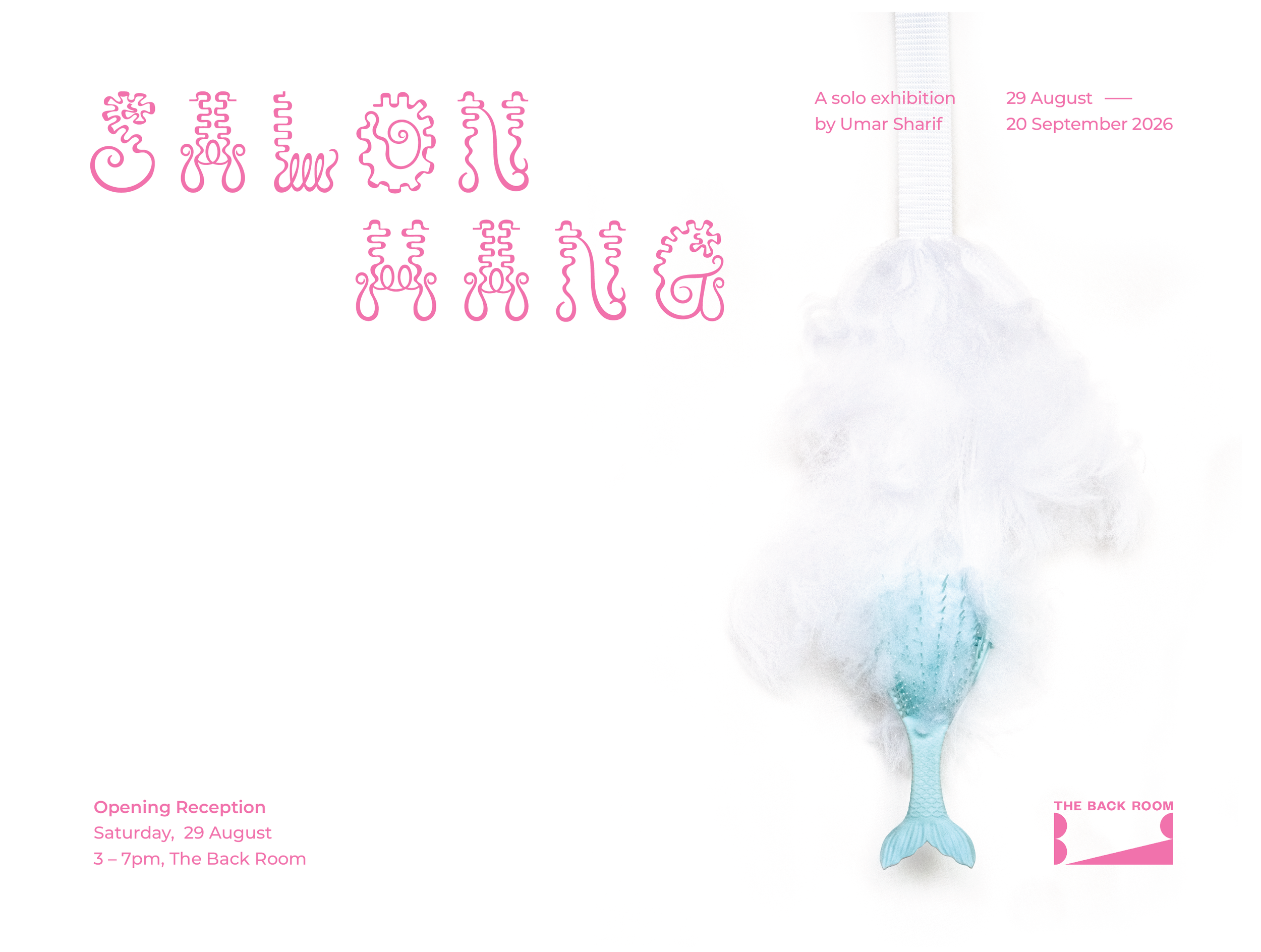
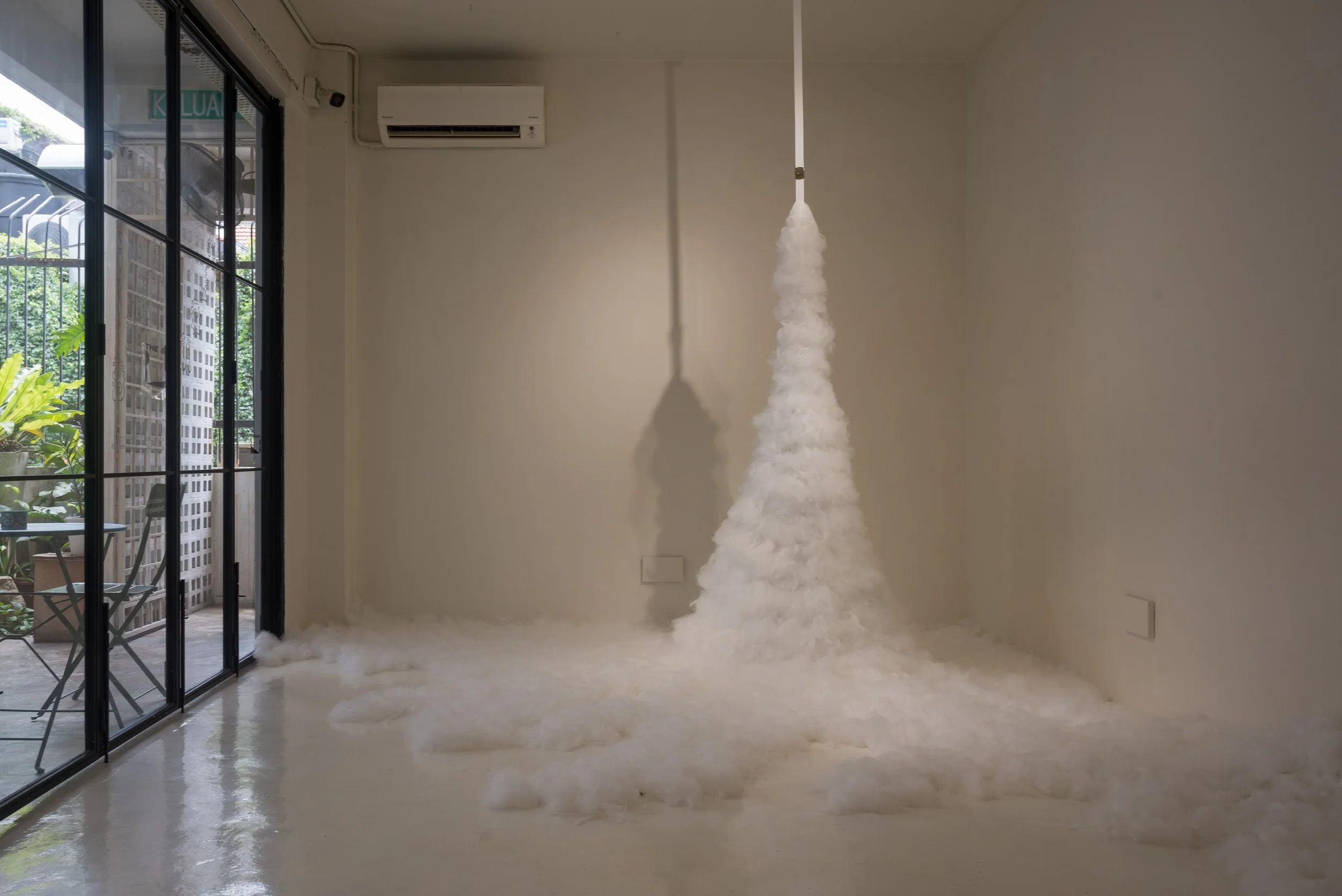
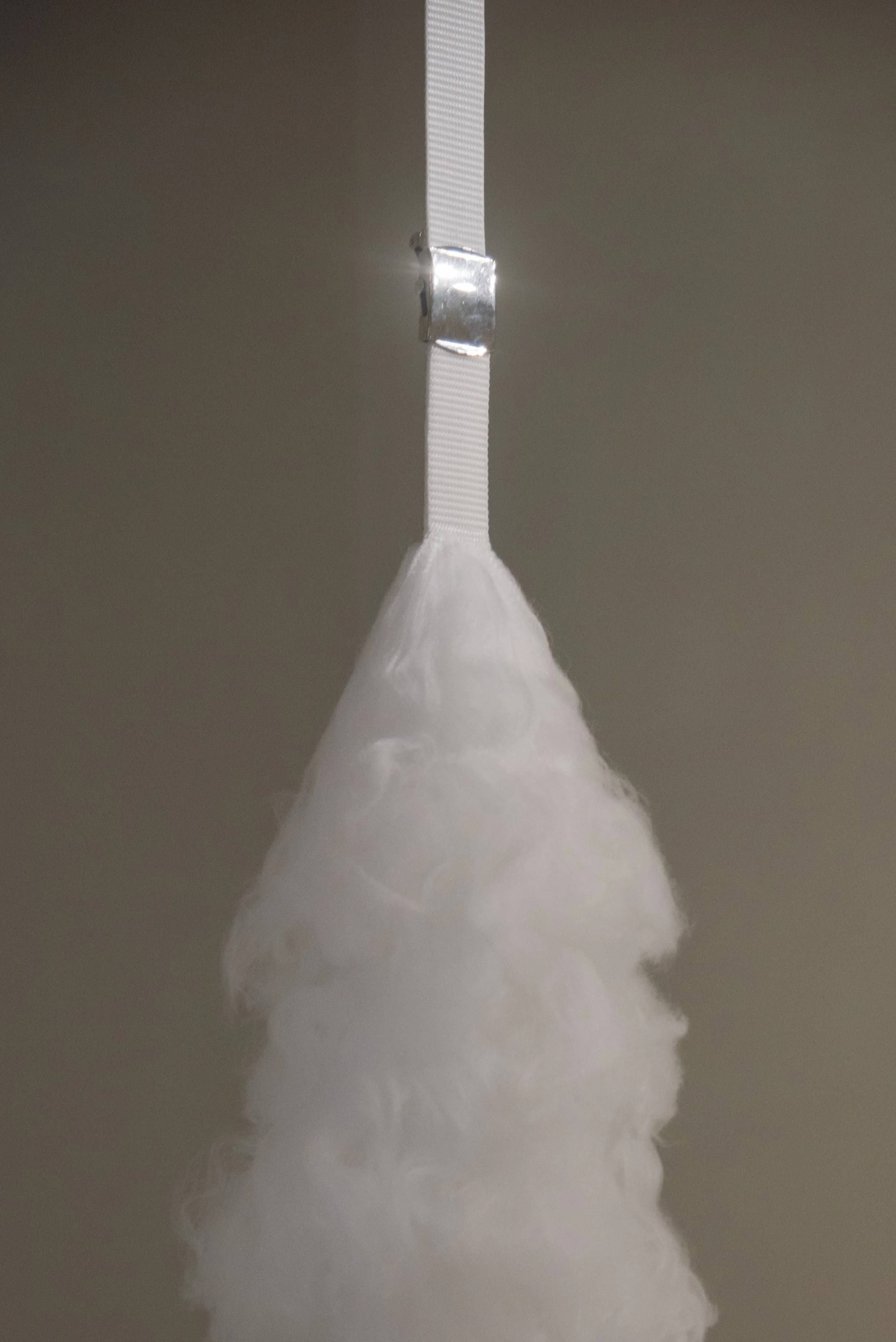
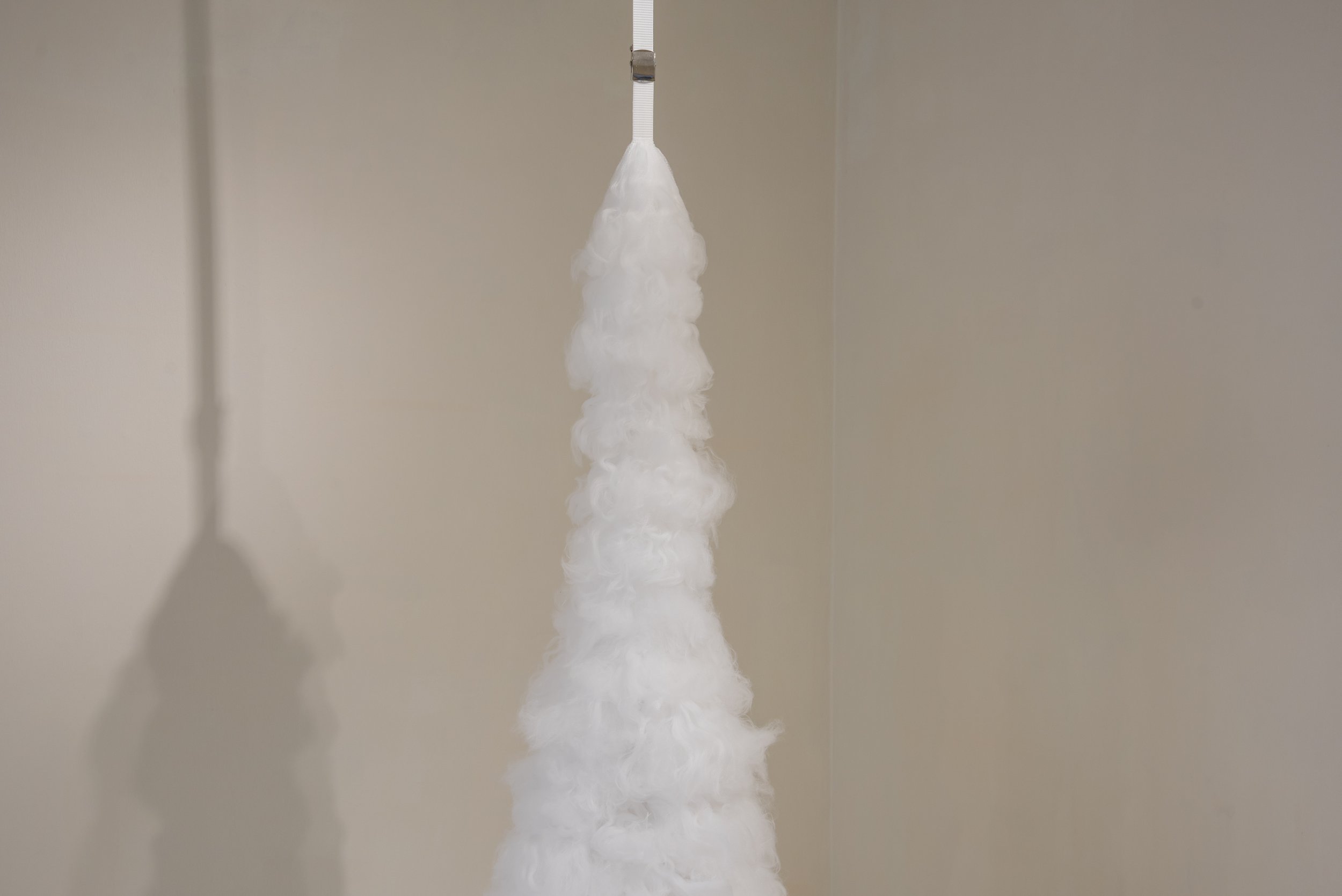
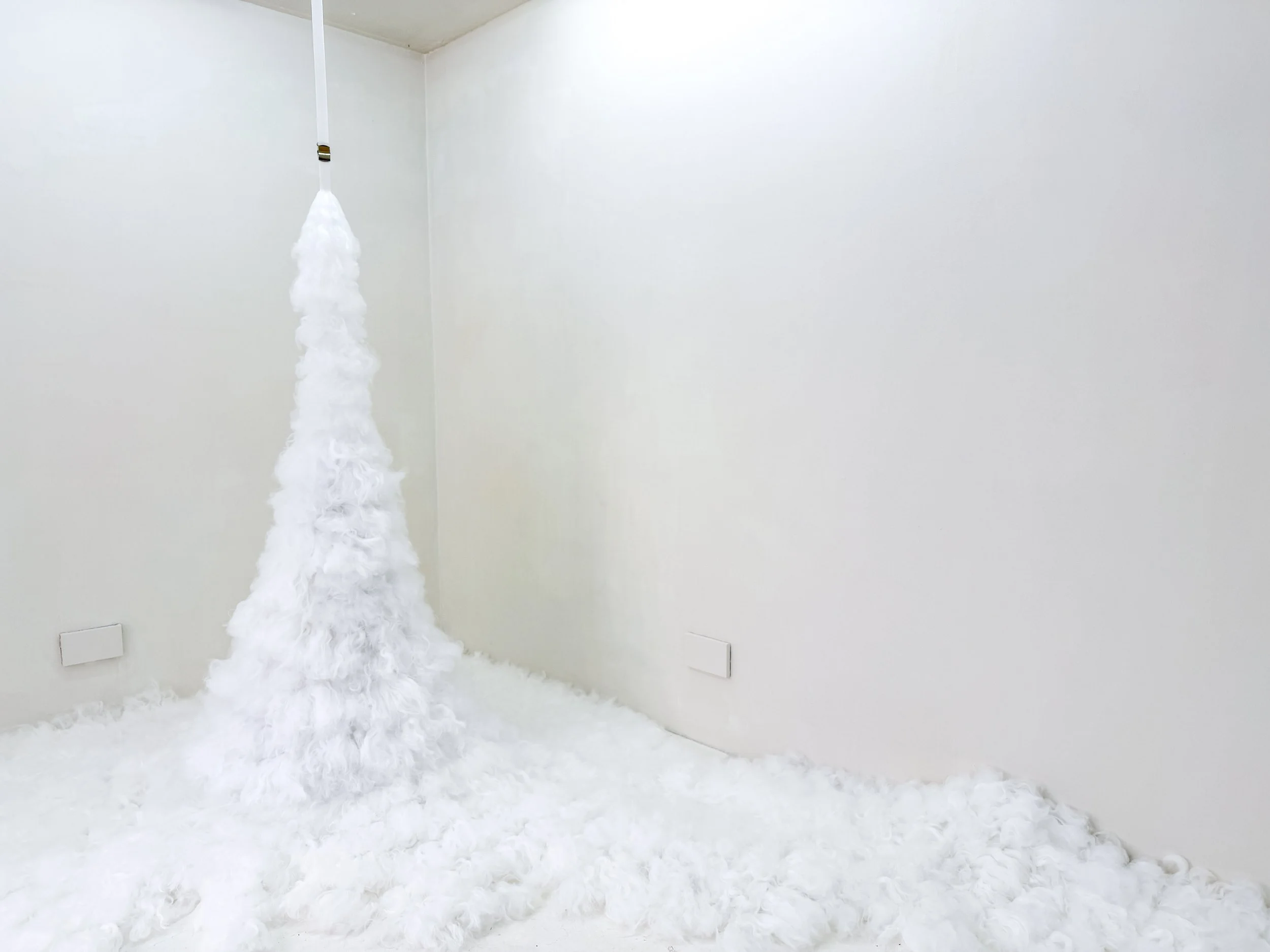
Dandanan I (2026) scales the confession. Where Asuhan dan Dandanan mustered an assembly, here there is a single belt, an individual: white like the standard-issue school shirt, white like a bridal gown, white like the kafan, the burial shroud. The belt drops from the ceiling. It holds its weave like a plumb line, regulation straight, the vertical of the flagpole and the ruled margin, and then, as it nears the floor, it detonates: strands bursting outward, sweeping the breadth of the room, cresting and falling like hair mid-toss, frozen at the instant of release. In the earlier works, the hair escaped the belt gradually, towards the end of its length, like a body outgrowing its uniform. Here the proportions have reversed. The belt is the brief episode; the explosion of strands is the condition. The langsuir permitted her merry-making at last.
Seeing such belts again under the auspices in a gallery setting, lit like museum specimens, is a strange thing. In primary school I was a problem kid, and I learnt early what it meant to kena tali pinggang: the belt as a raw instrument of threat. In secondary school I was co-opted. Rebels, they say, make the best enforcers; Anwar Ibrahim, considered the foremost firebrand youth leader of his generation, went to become the golden boy of the new UMNO. I became a prefect, and eventually deputy head. My job was, in part, to keep the belt trade moving. Each prefect carried a black book that meticulously recorded names, dates, offences, the fine for each, the running total at the back. The highest fine by far was the offence of the belt. Arrive beltless, or wrong-belted, and you were forced to buy the regulation article from a prefect at an exorbitant price.
So when I saw Umar’s belts, before I could audit myself, I was already scanning them. The old training had switched itself on, twenty years decommissioned, and my eye was already running the gate check: buckle non-regulation, width over the limit, weave compromised, colour off-white, ornamentation present, ornamentation flagrant. Somewhere in me a black book was opening. I stood in a gallery pricing deviations, the most expensive belts I had ever seen, offences beyond the schedule of fines, contraband past all confiscating: webbing that had given up pretence entirely and burst into ringlets, into gothic volume, into gorgeousness. Then the body caught up with the eye. A prickle across the forearms; an involuntary laugh halfway; then, worst, an irresistible desire to touch. This is the thing of punishment, the thing I had sold, and yet the thought that preoccupied me now was simply: How soft they look. How beautiful.
Back to Roots
Kalau kusut, kembali ke pangkal jalan. When things tangle, return to the beginning of the path.
Once every few months, Umar returns to the family home to cut his mother’s hair. They set a chair in the garden, so that whatever strands escape the sweeping can return to nature. There is no audience. She offers him her nape; her hair grows thick and makes her feel hot, so the ask to Umar is to trim below the nape, and leave enough on top to tie. Wielding comb and scissors, he works.
Like many young children, Umar’s first compulsions of grooming was to play with the synthetic hair of Barbie dolls and their kin. But he had no dolls. His sisters were tomboys; there was nothing to sneak from their rooms. So he made his own. Hair first: strands of raffia string, clipped to a teddy bear. And when there was no head to receive the hair, he used the one he had. His fist was the doll’s head, his wrist its neck; he styled the raffia around his knuckles, and a flick of the wrist sent the hair tossing. The raffia came before the belts. The first head he ever dressed was his own hand.
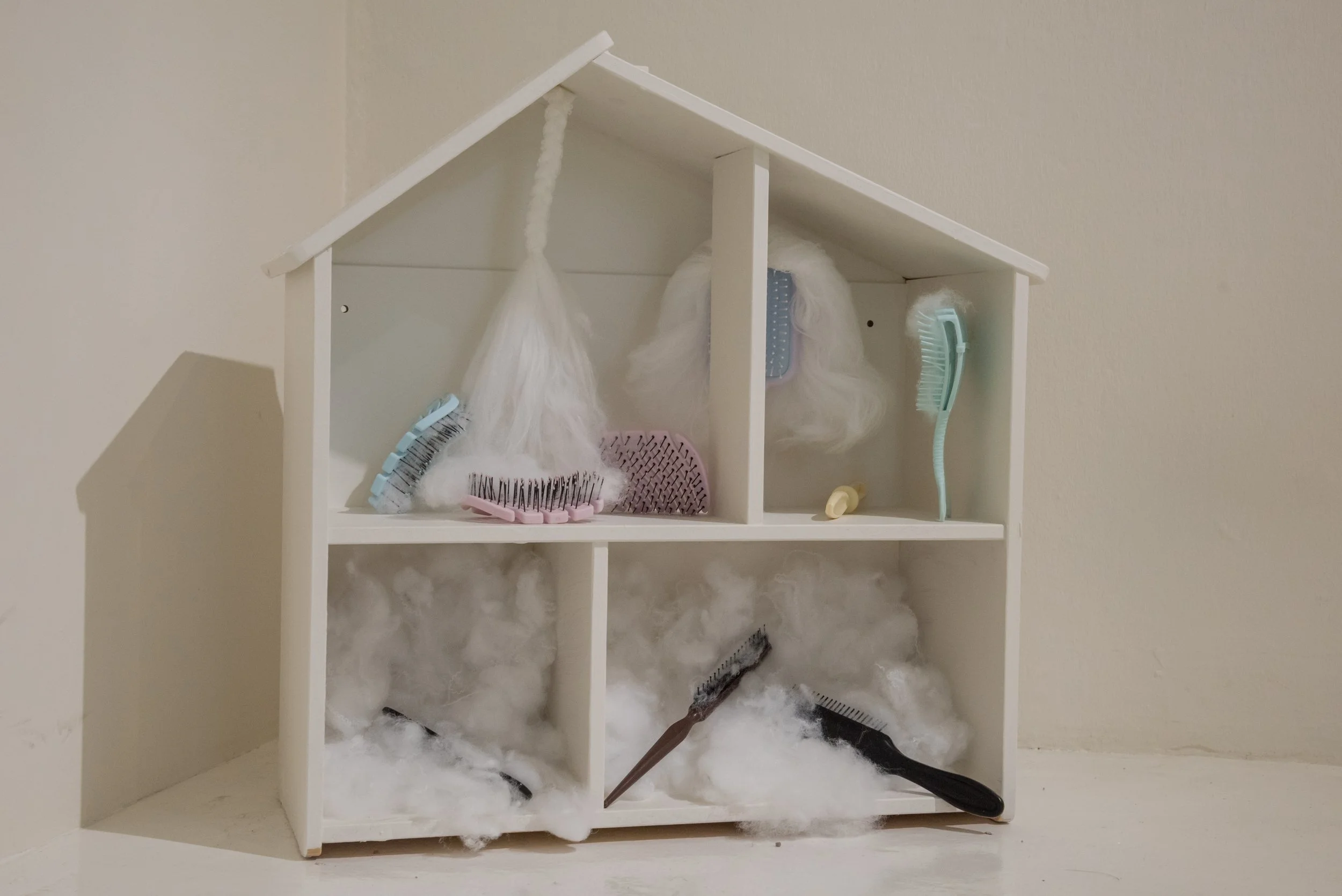
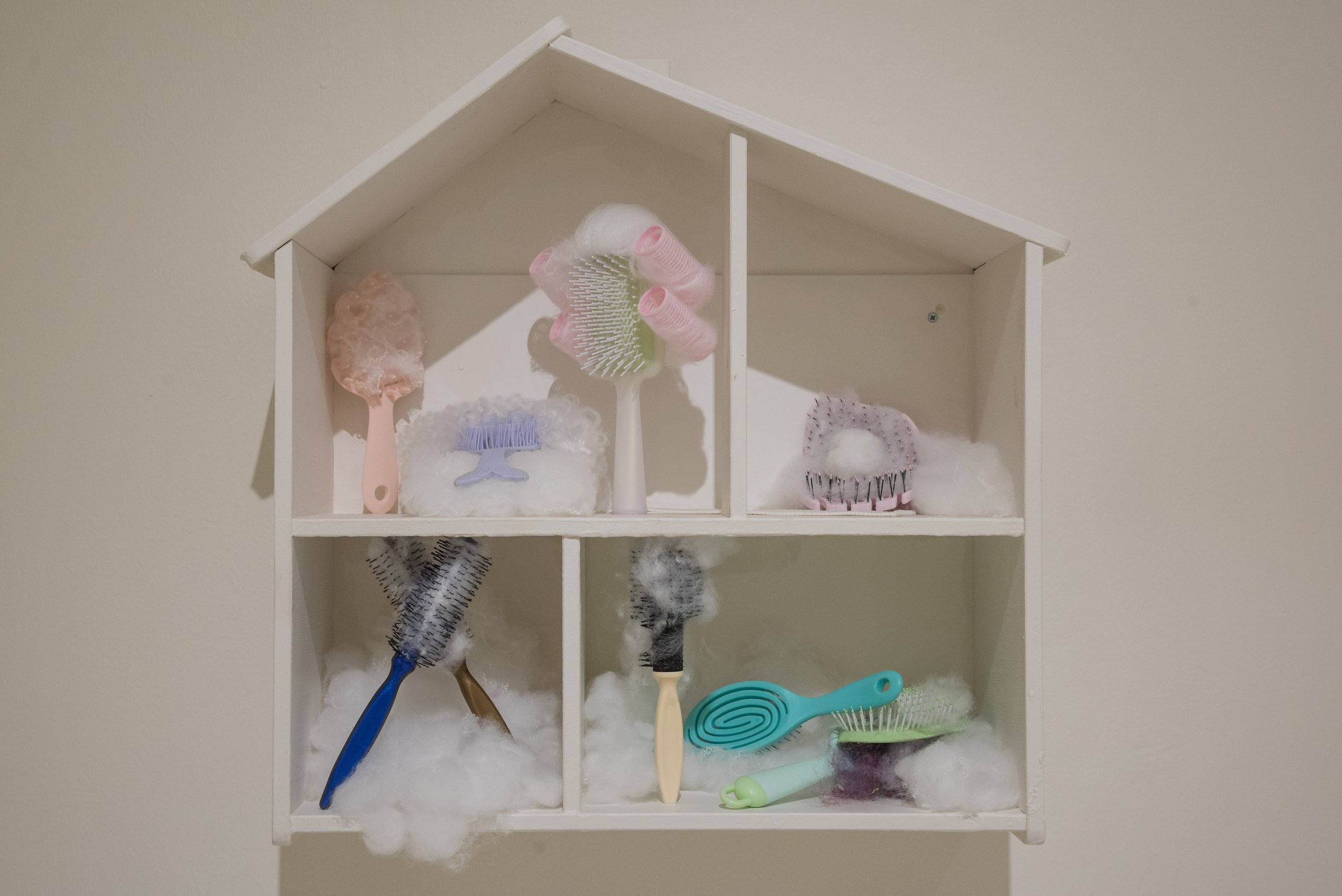
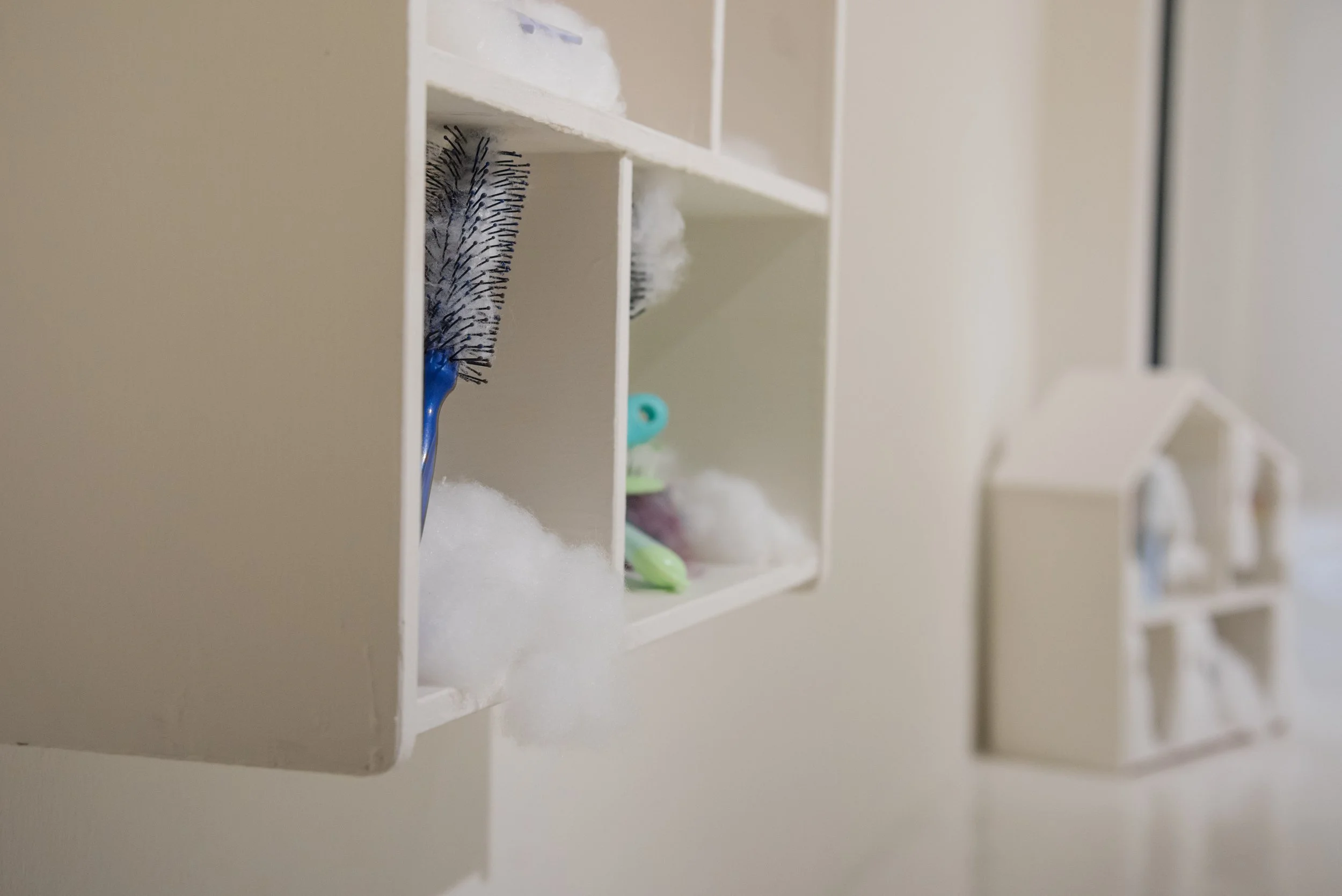
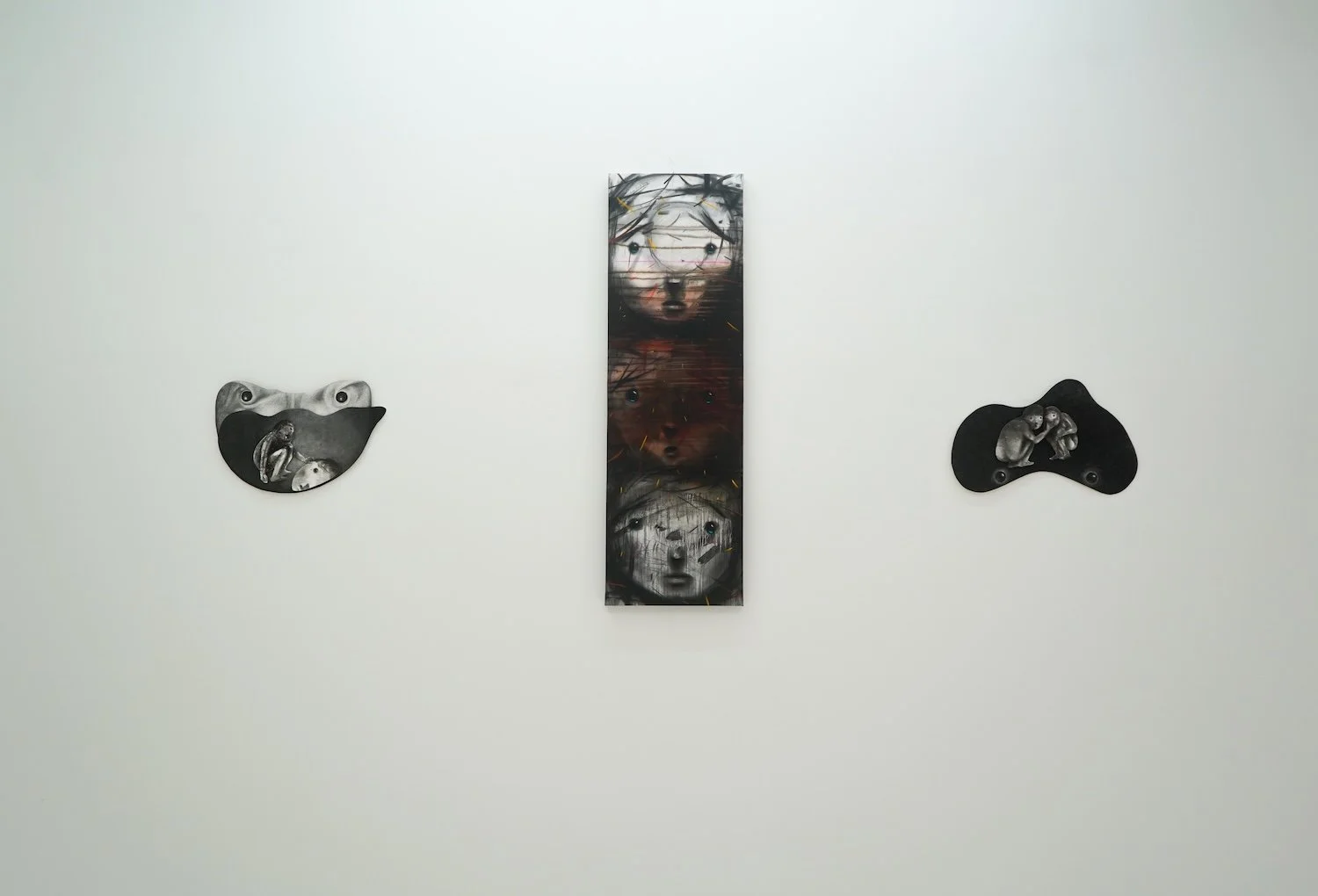
The belts’ beginnings lie here. Comb-lumbarium I, II, III (2026) is a dollhouse, painted school-uniform white, but its occupants are not dolls. What resides within are the combs: some broken, snapped, splayed, matted with polypropylene, teeth twisted and bent. A columbarium for combs. For all the jubilant release of the great white belt, its hair let down across half a room, here lie the casualties of that release, a reminder that any reshaping is violence, is pushing against resistance.
And yet, on his mother’s hair, the comb goes through.

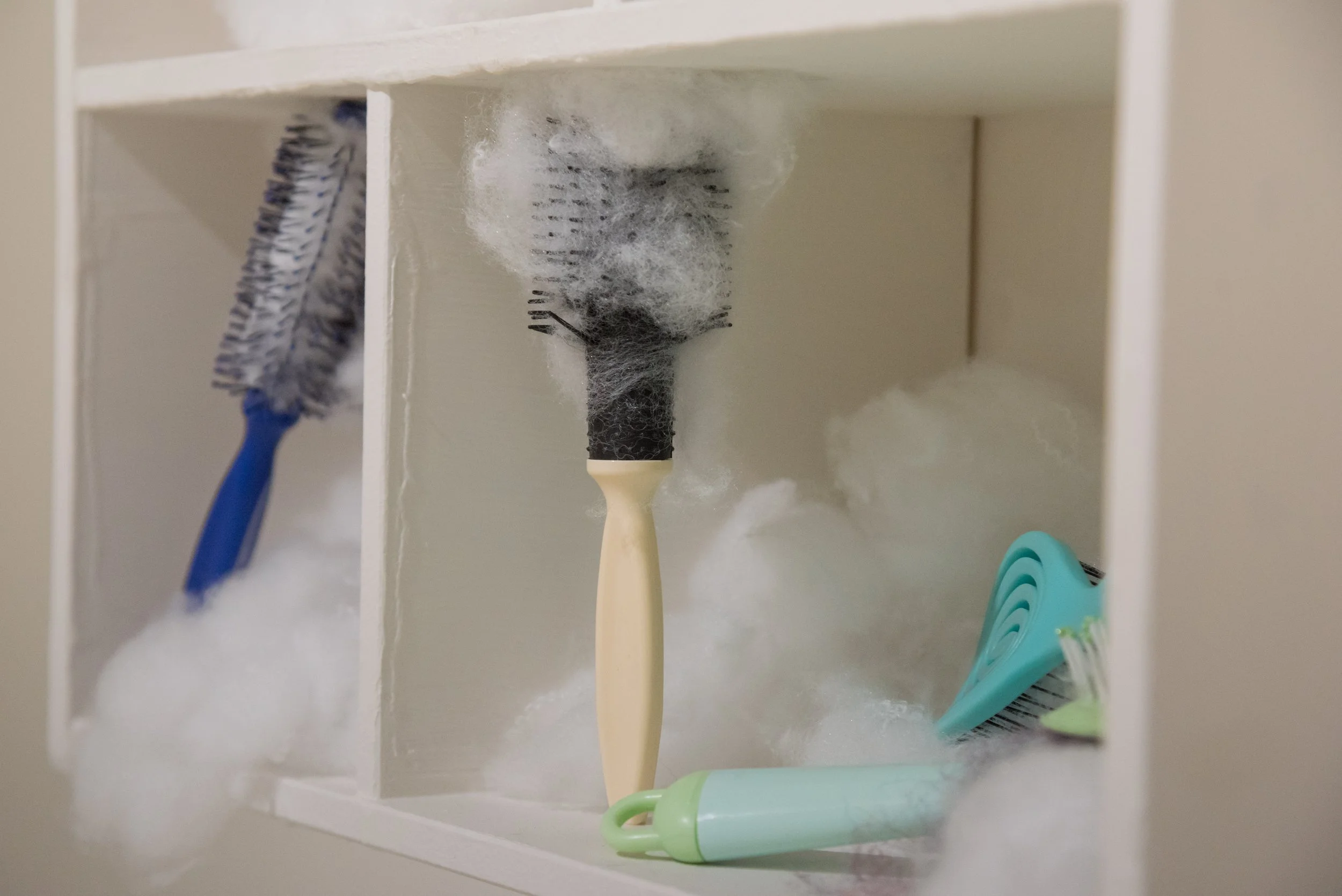
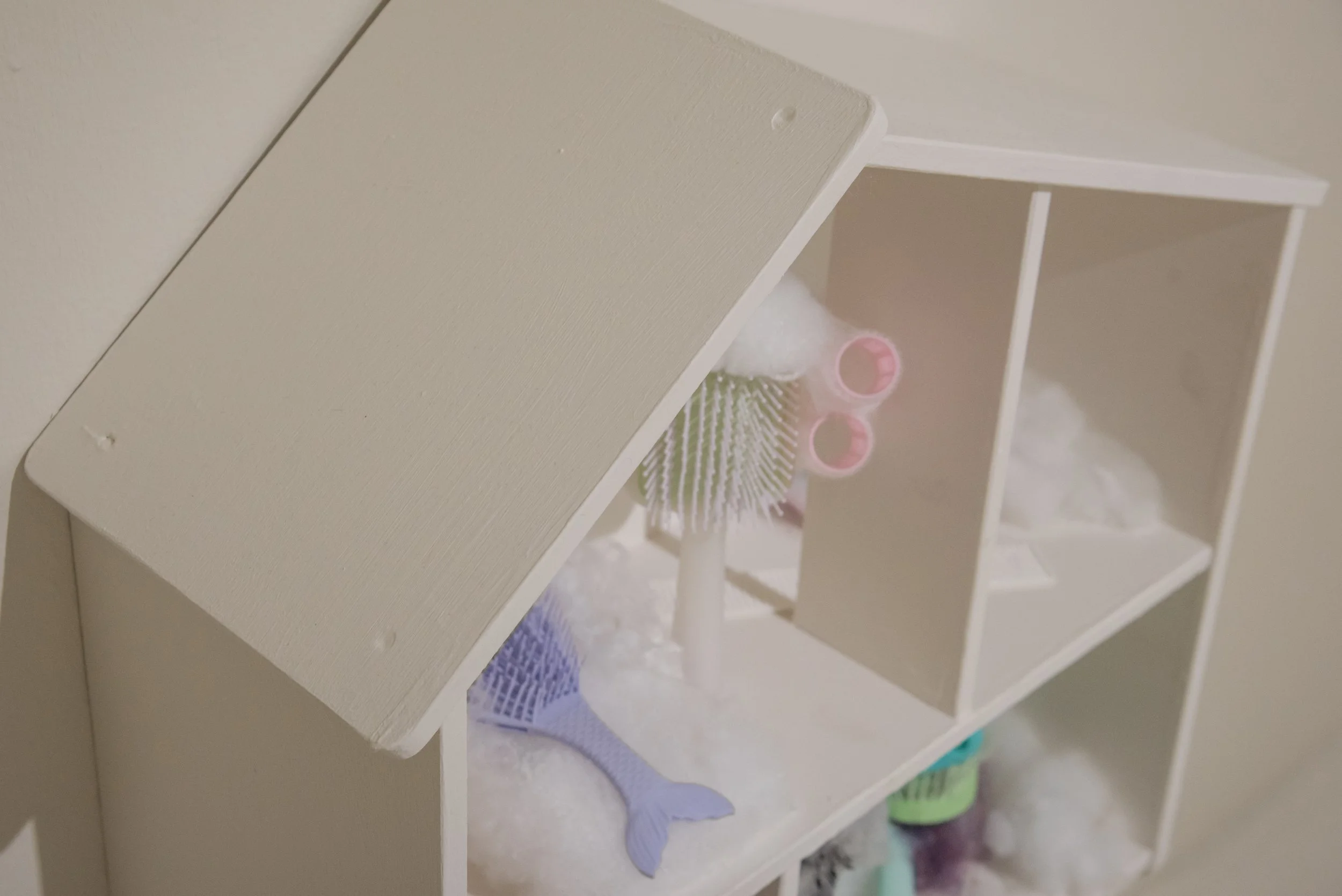
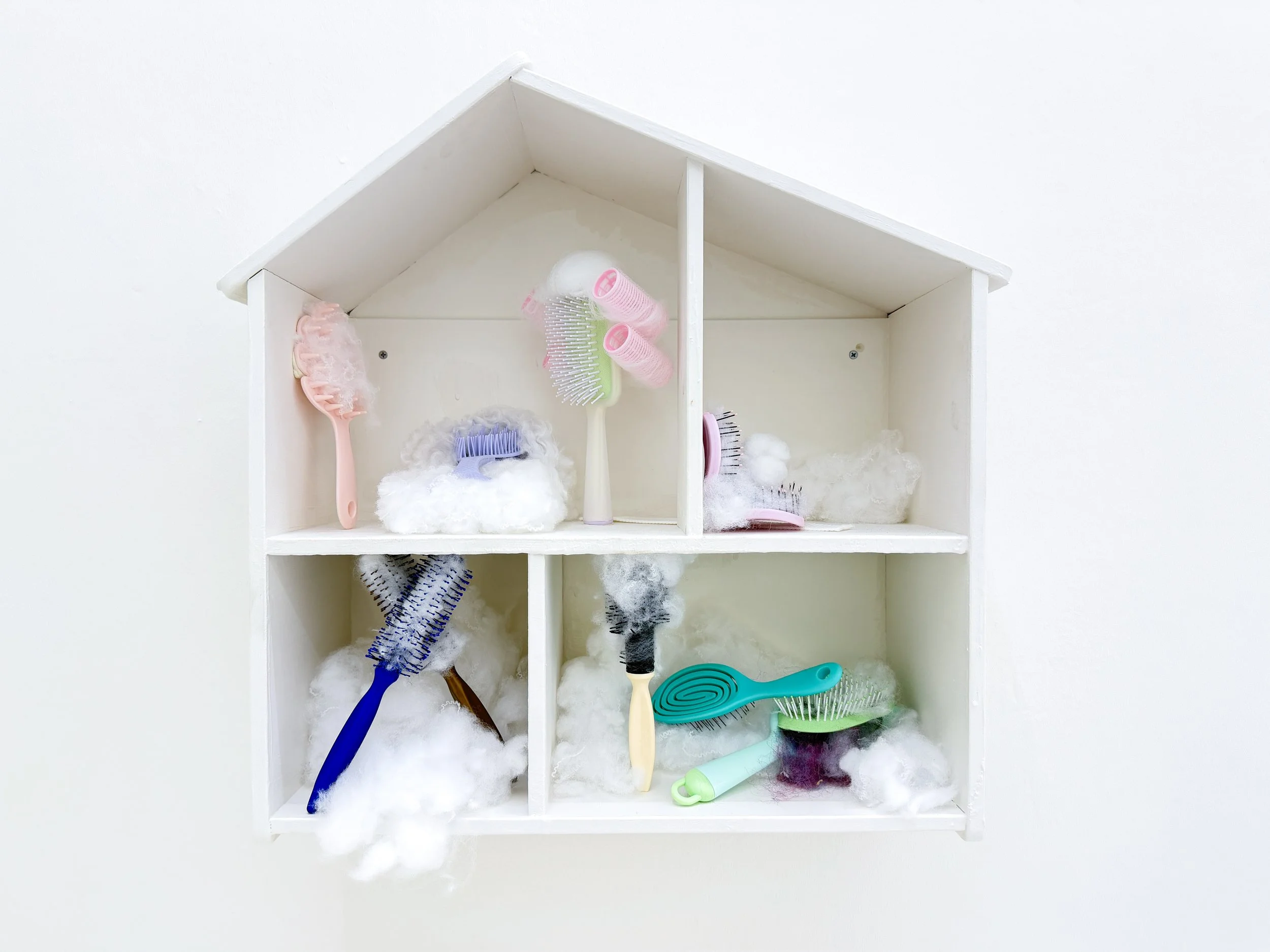
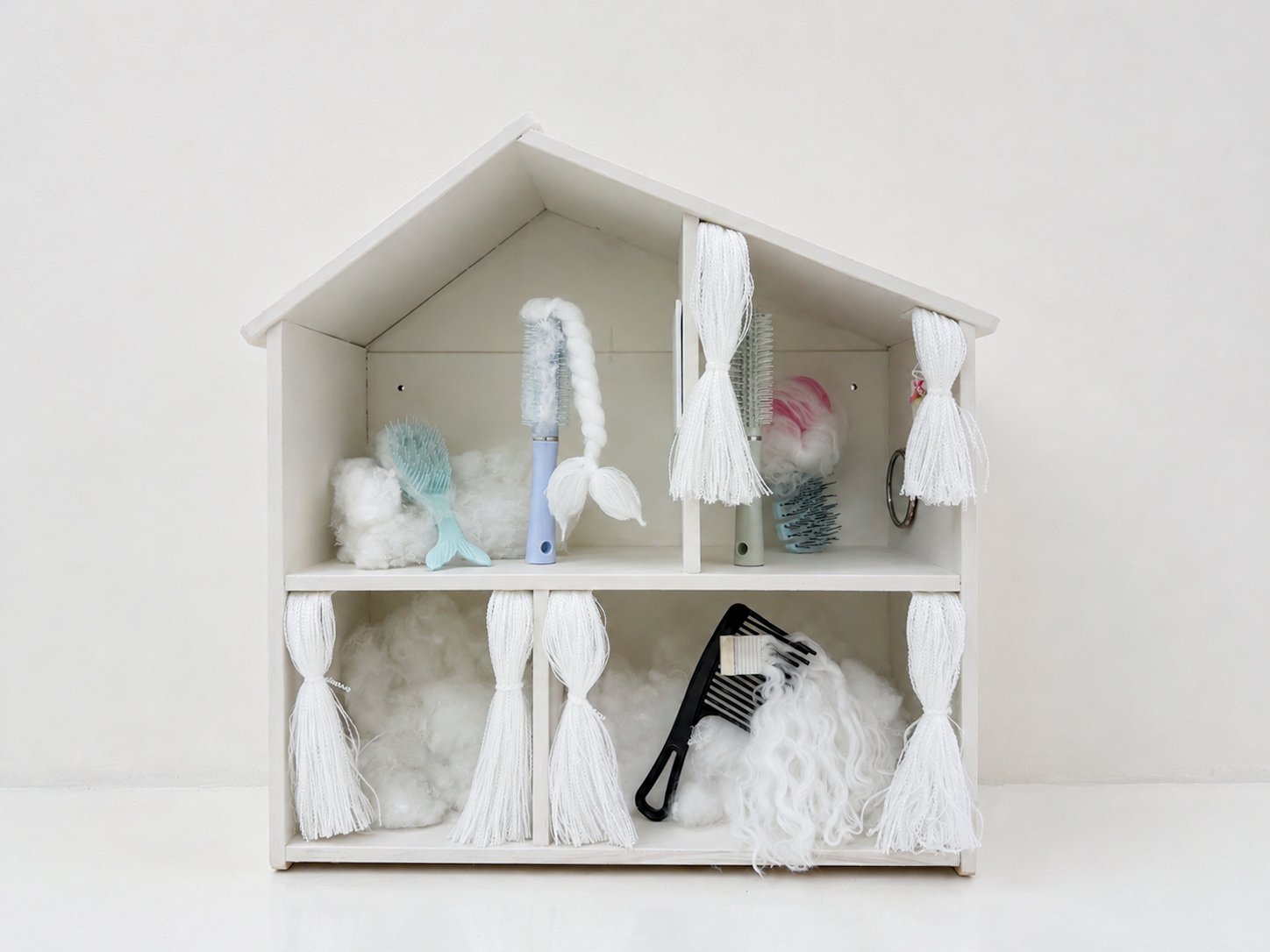
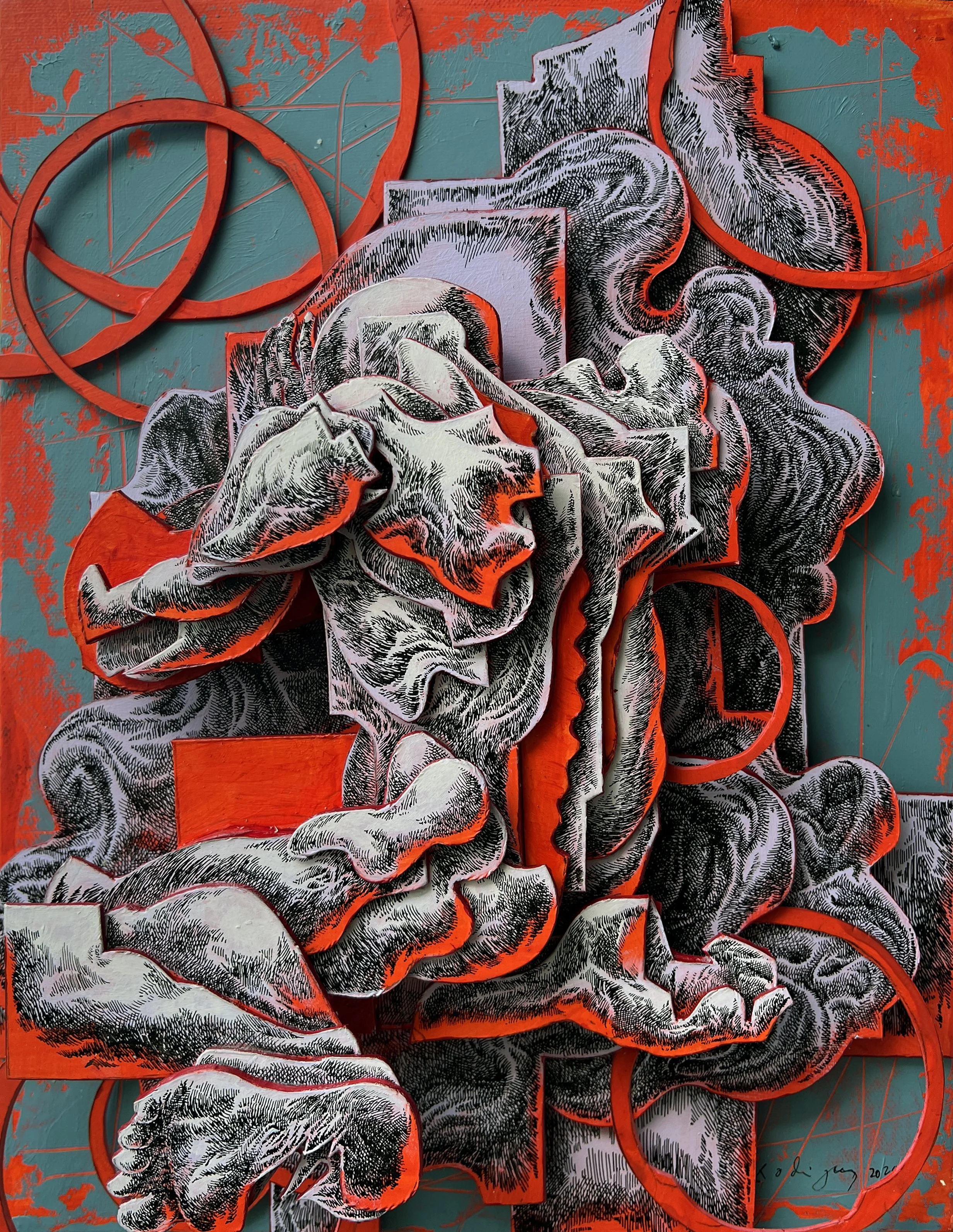
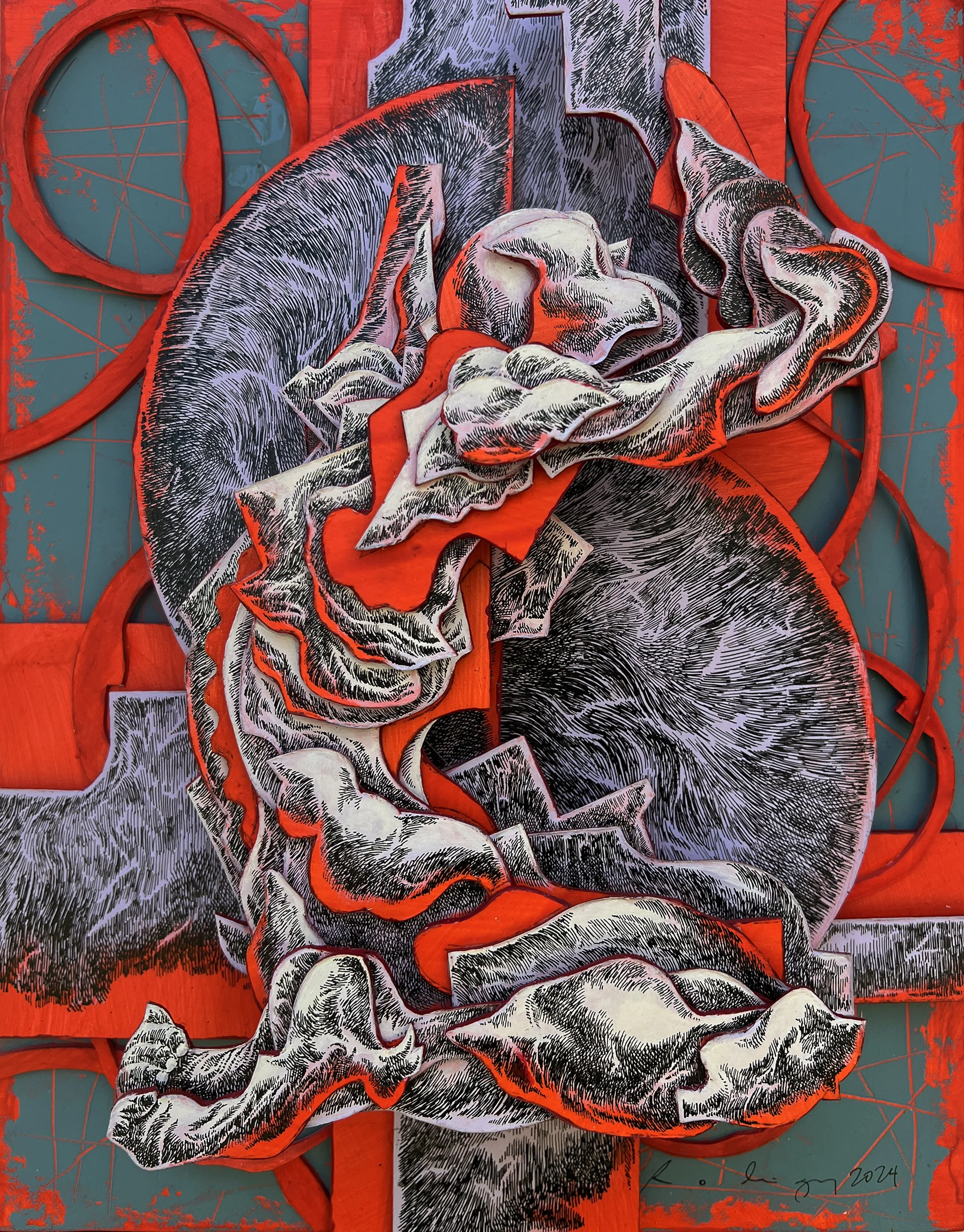
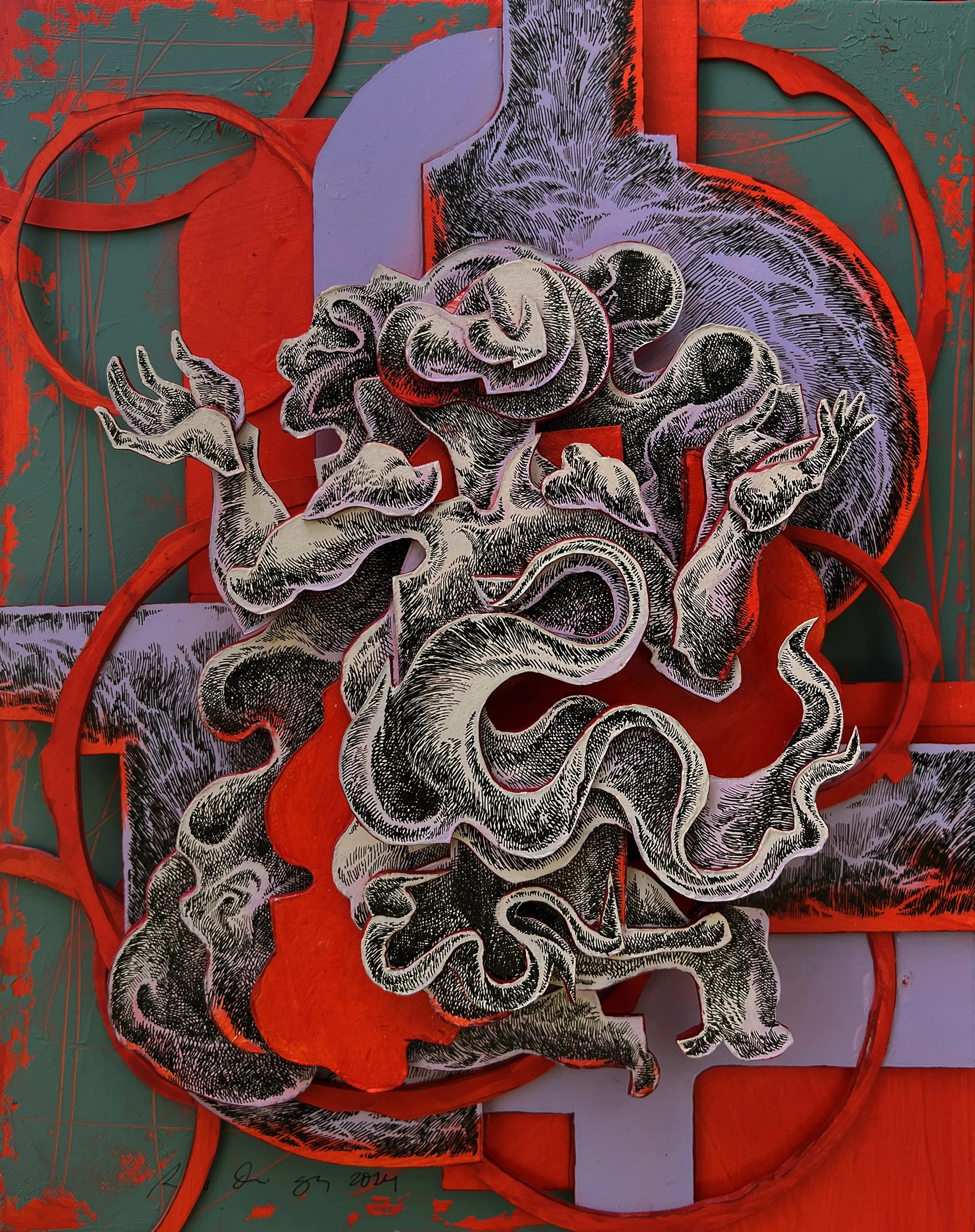
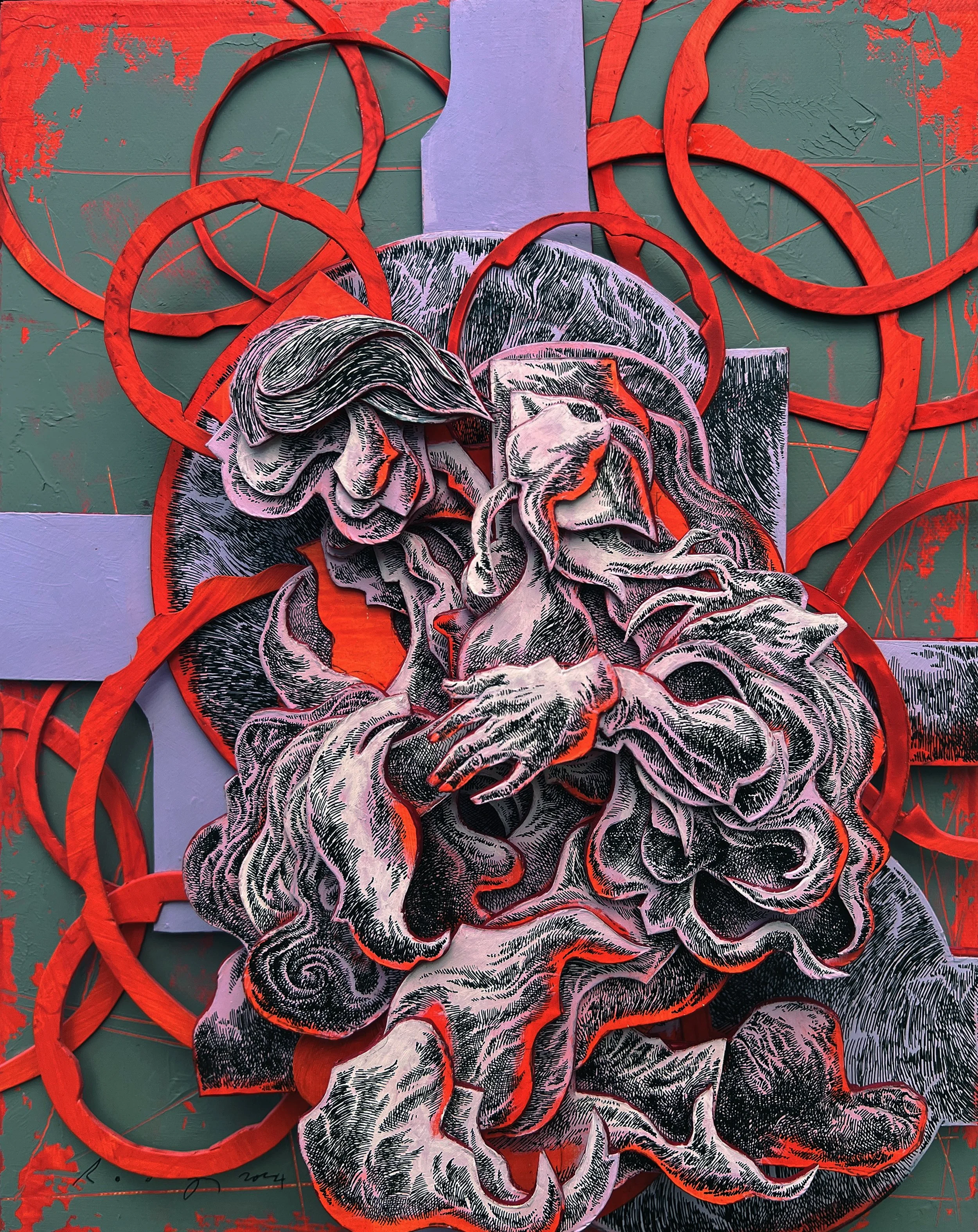












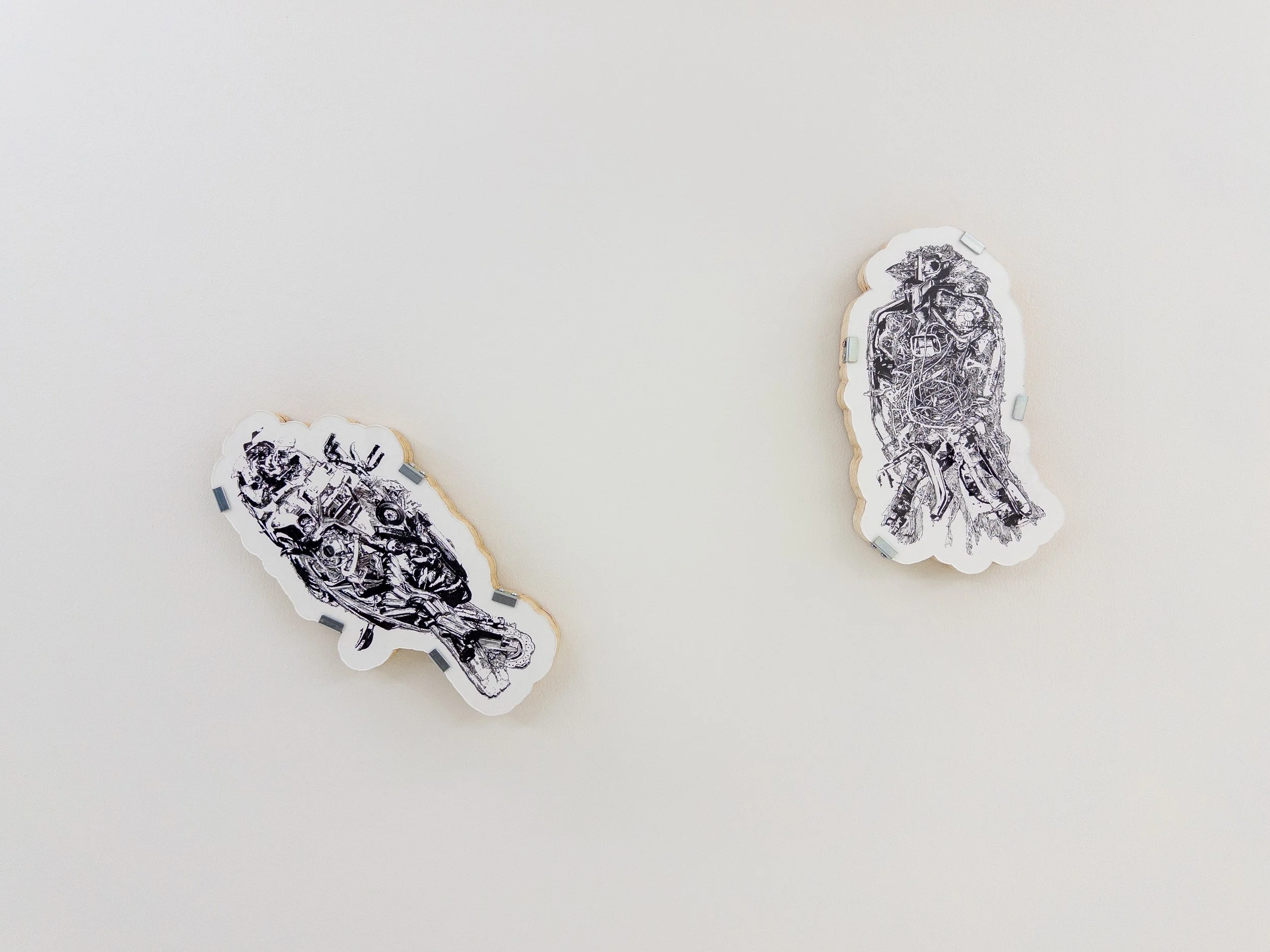
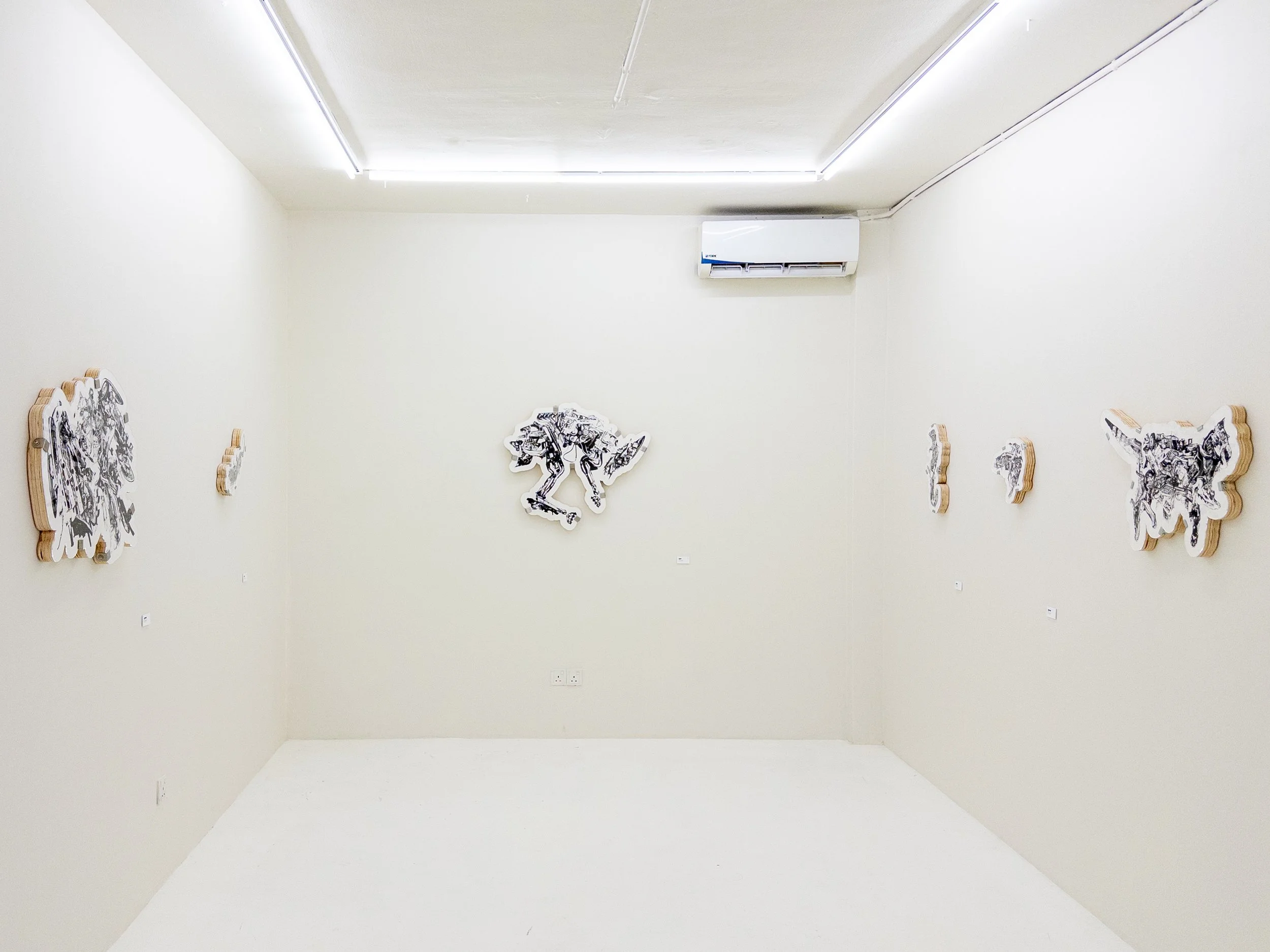
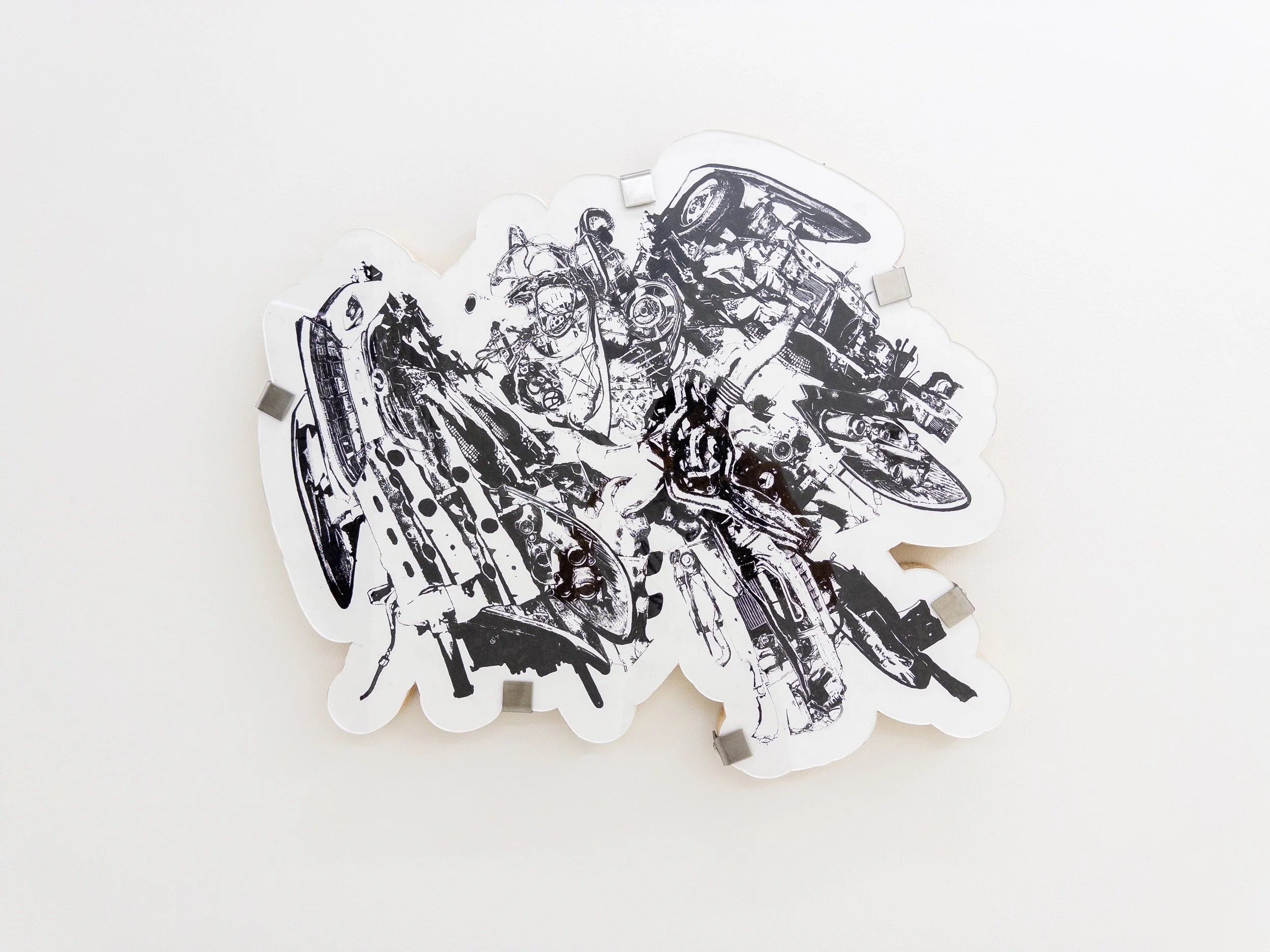
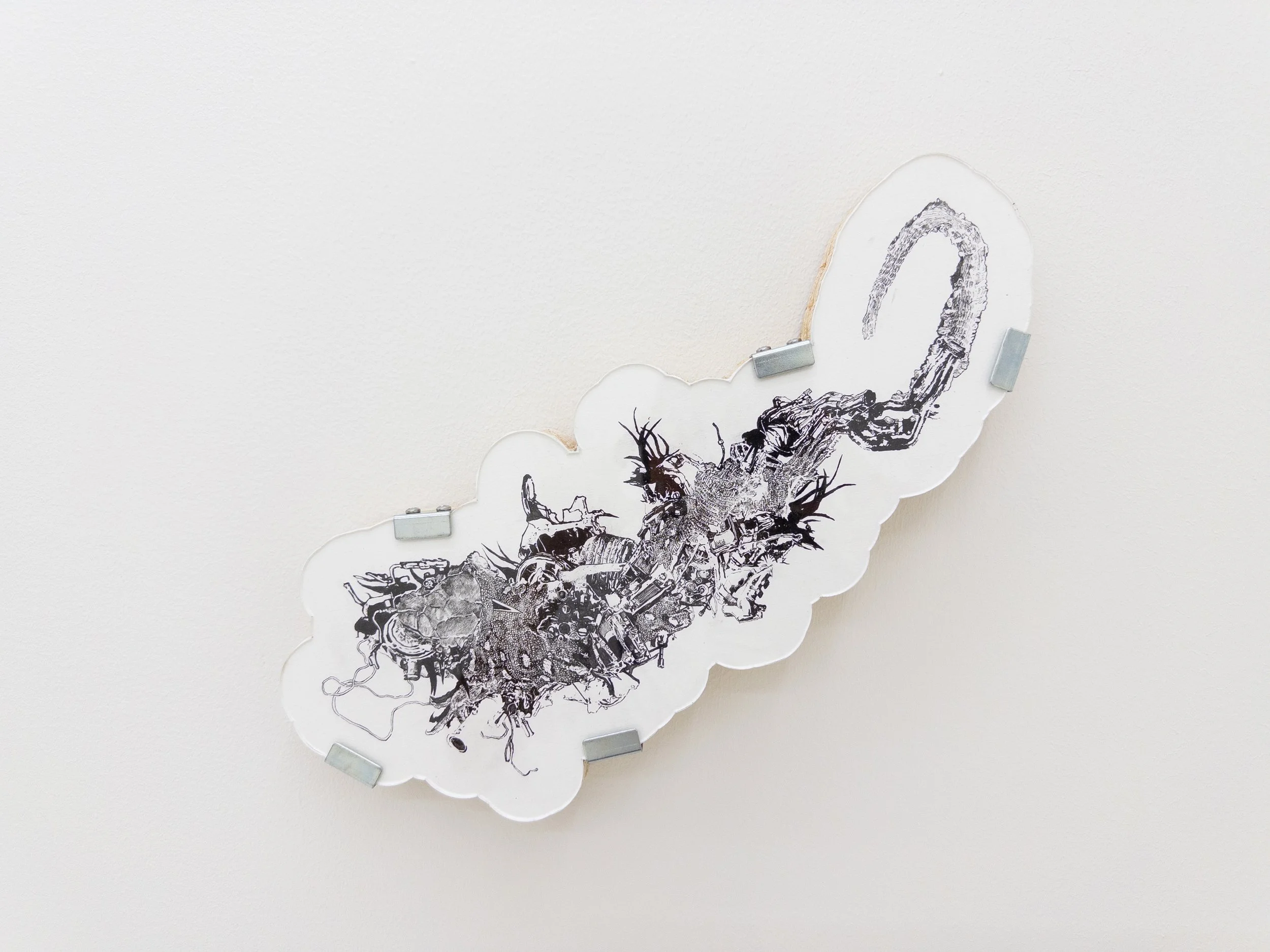
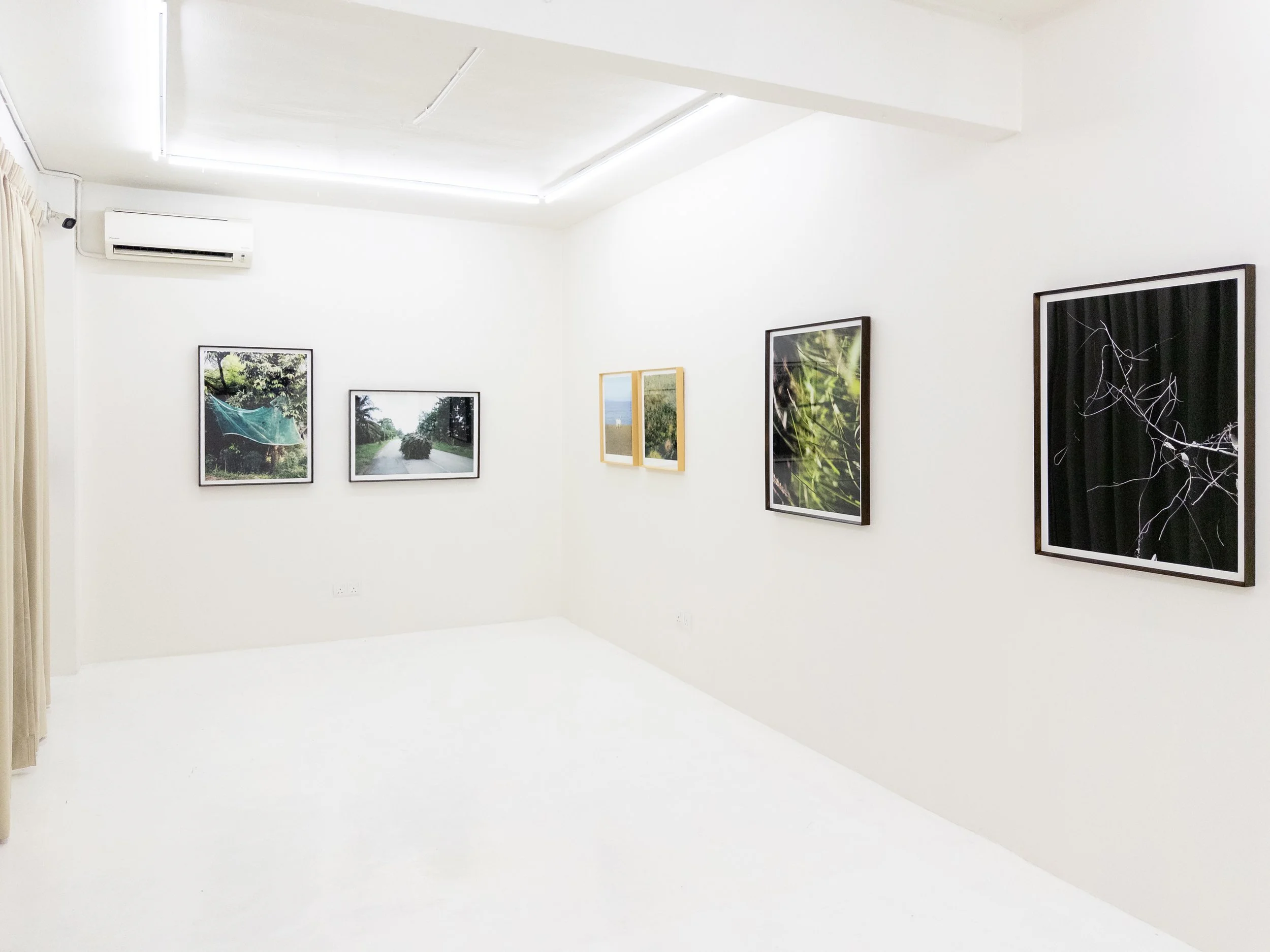
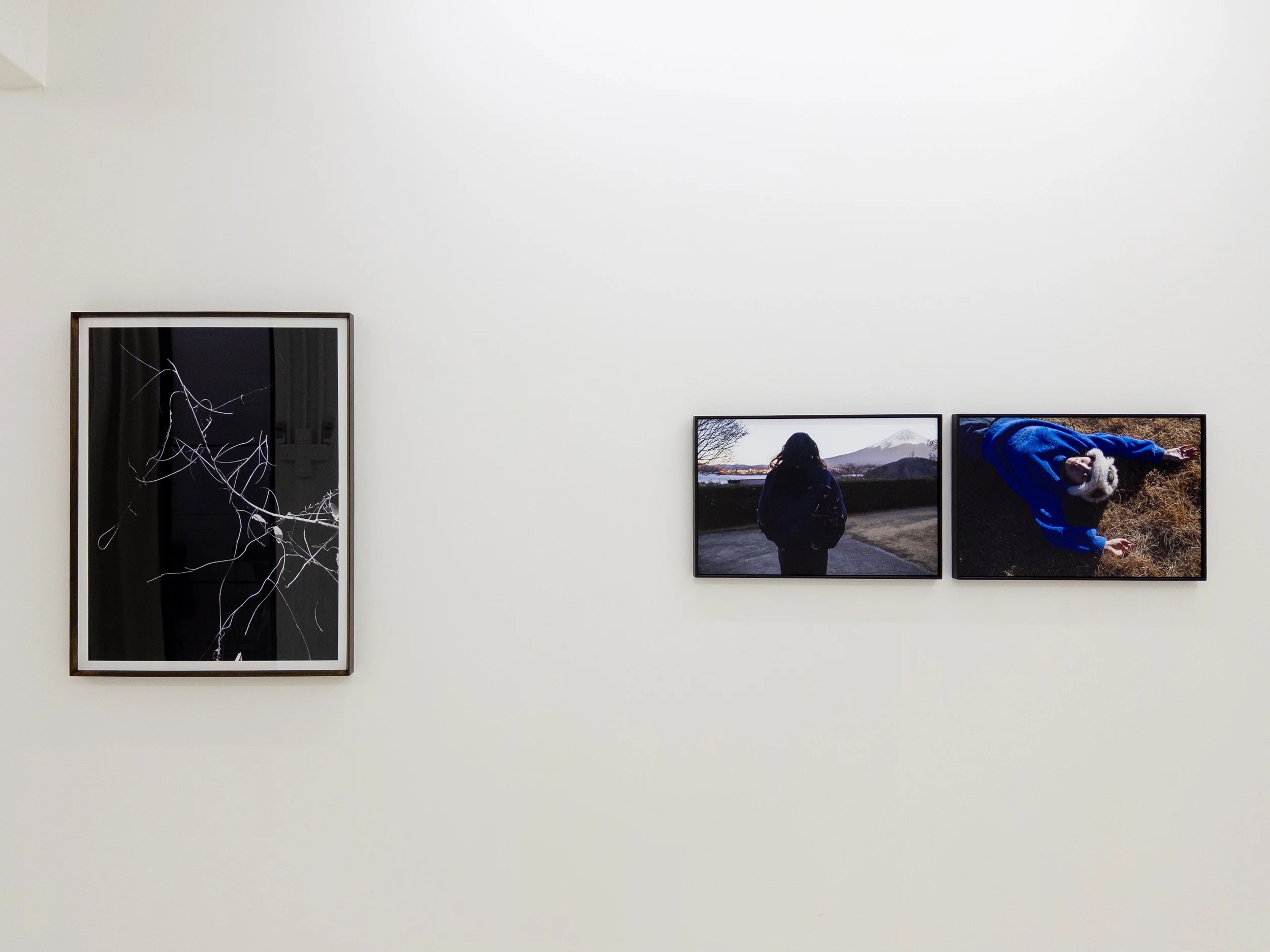
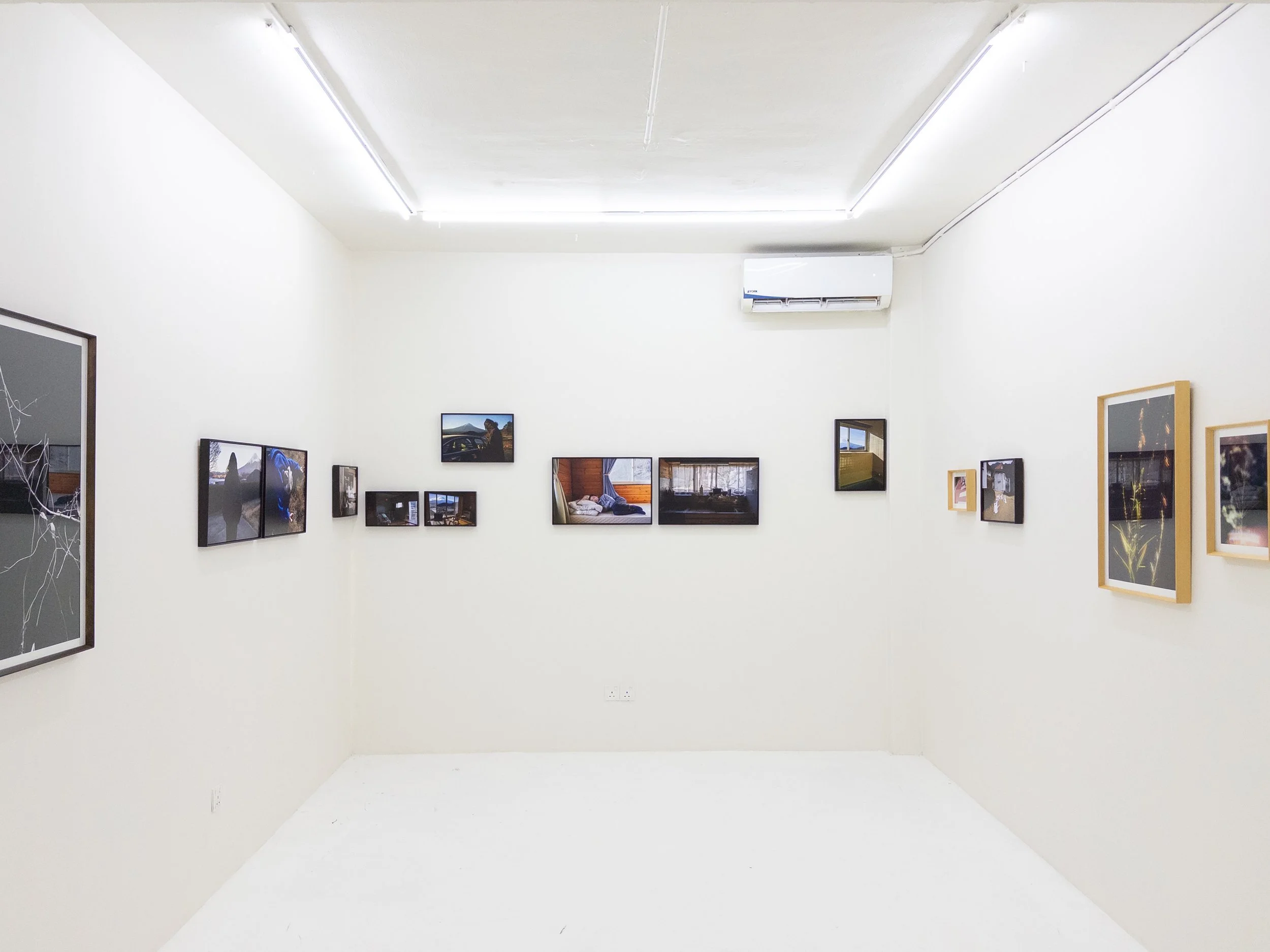
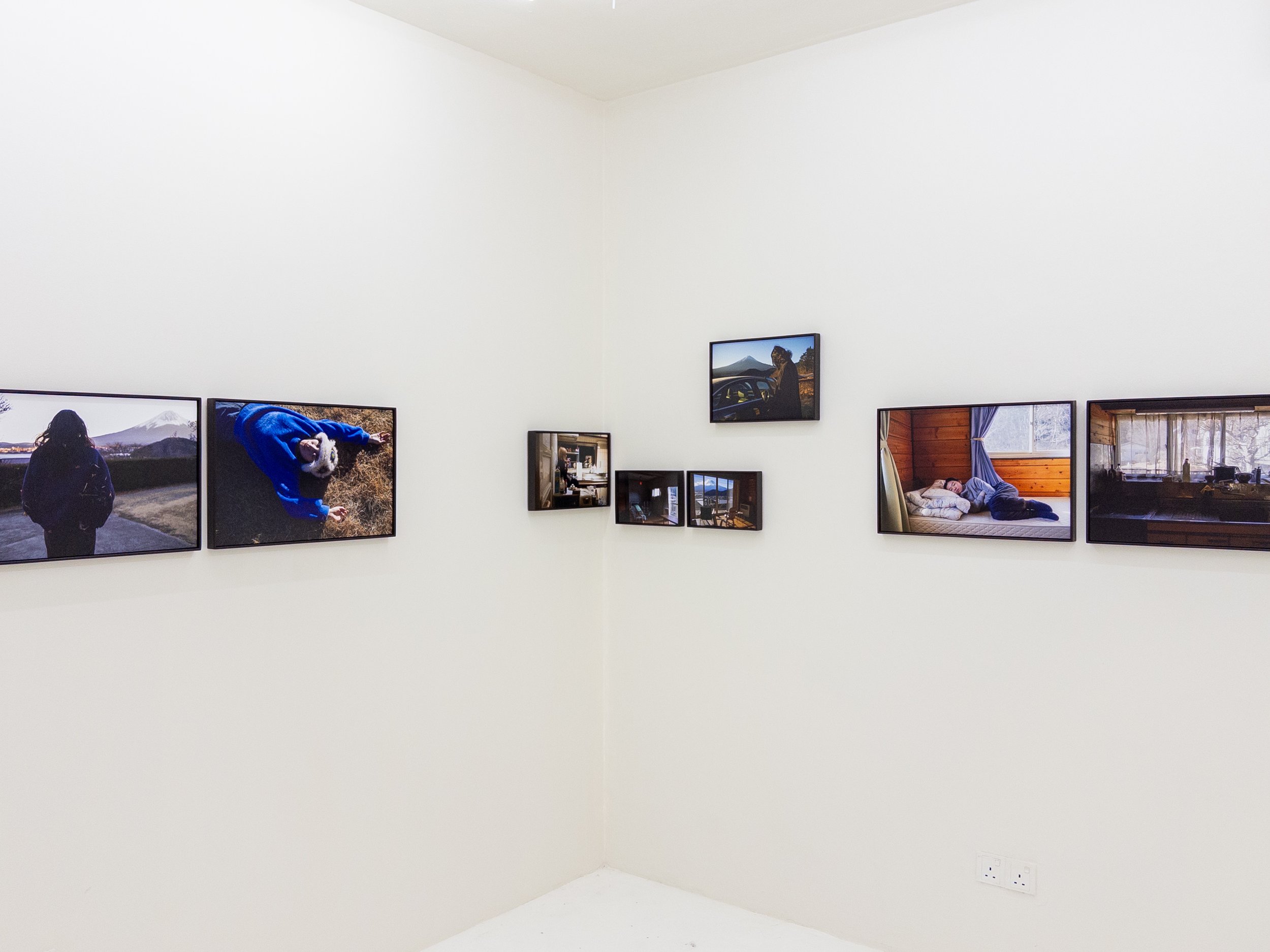

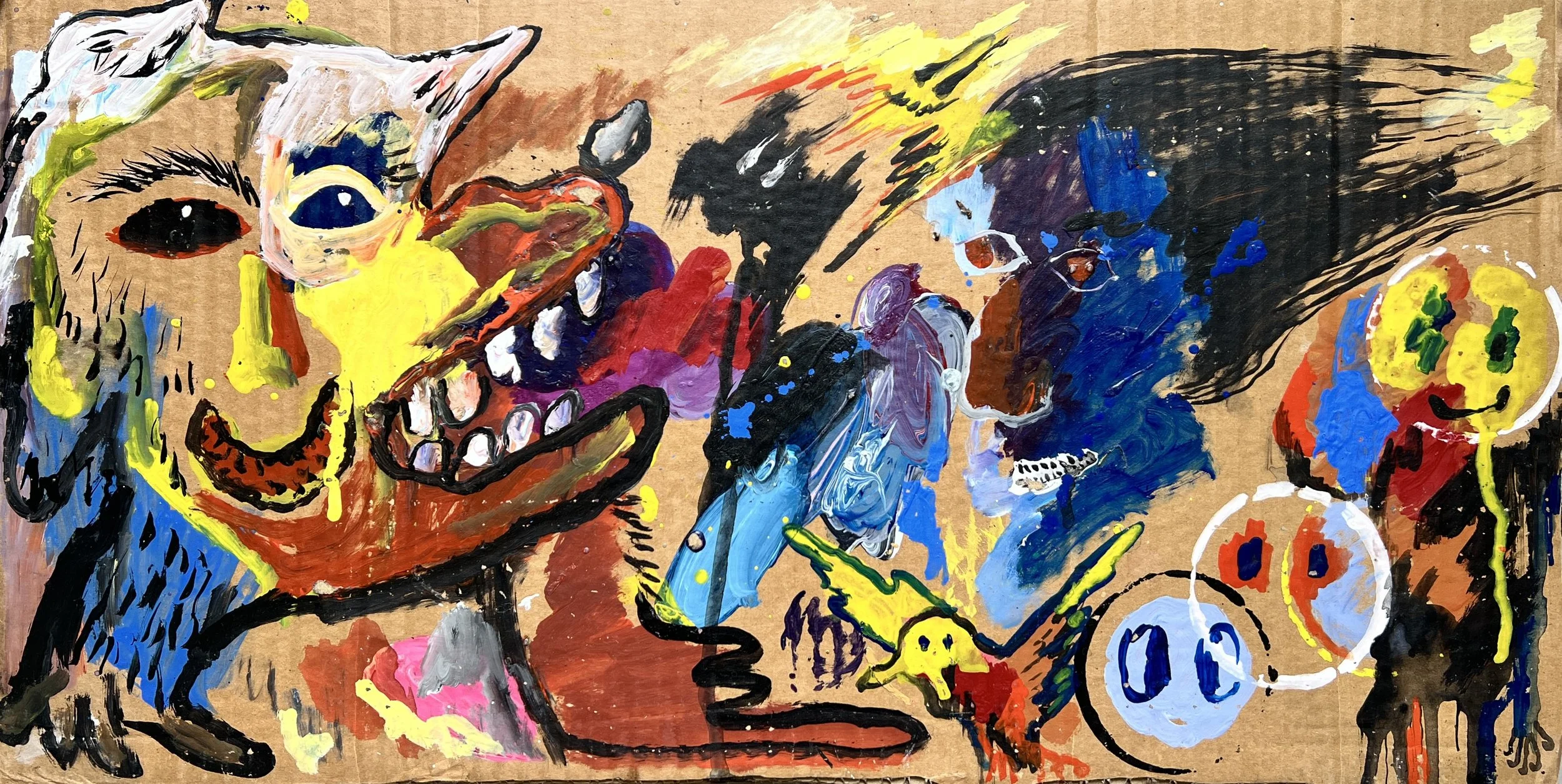
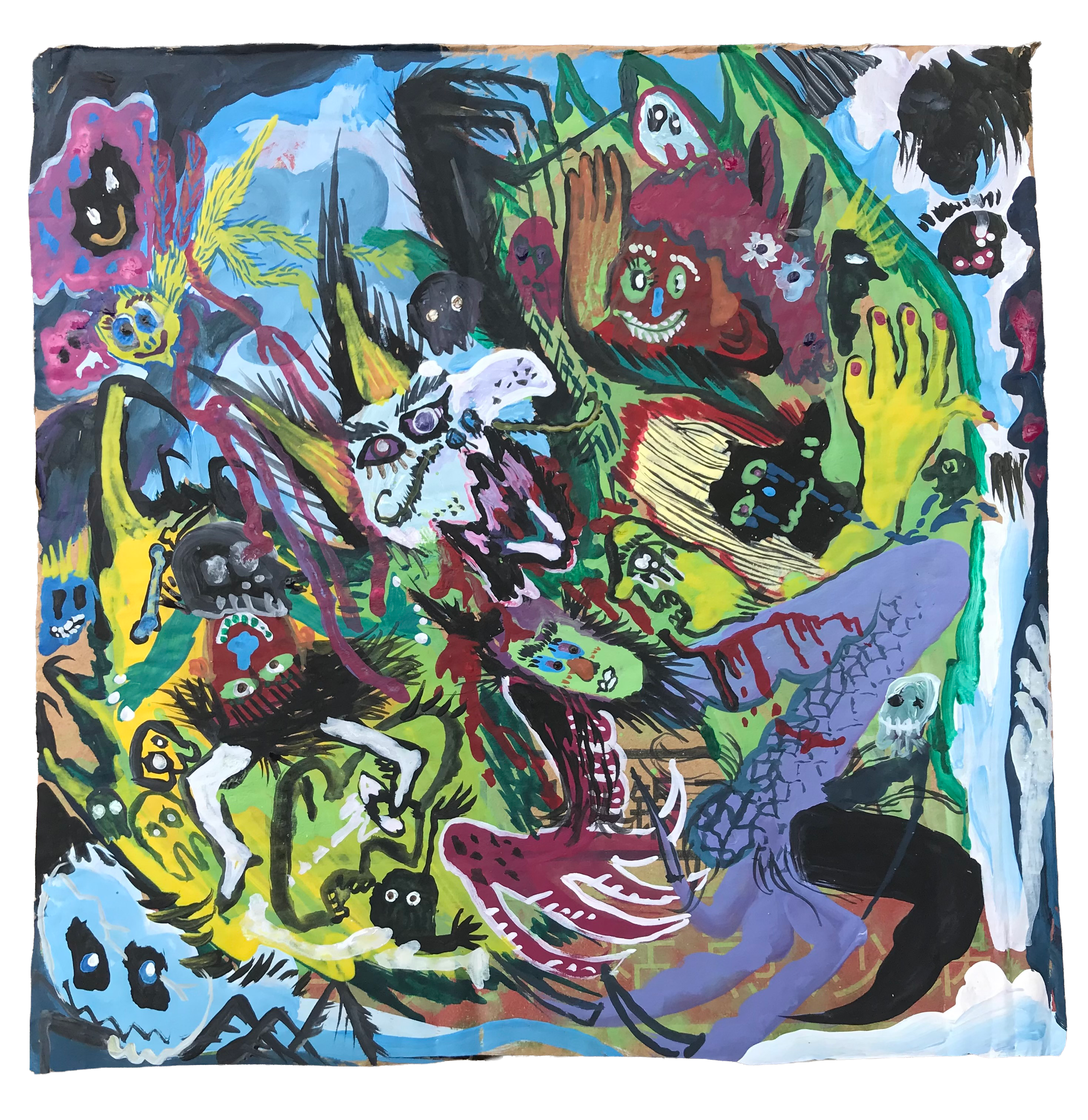
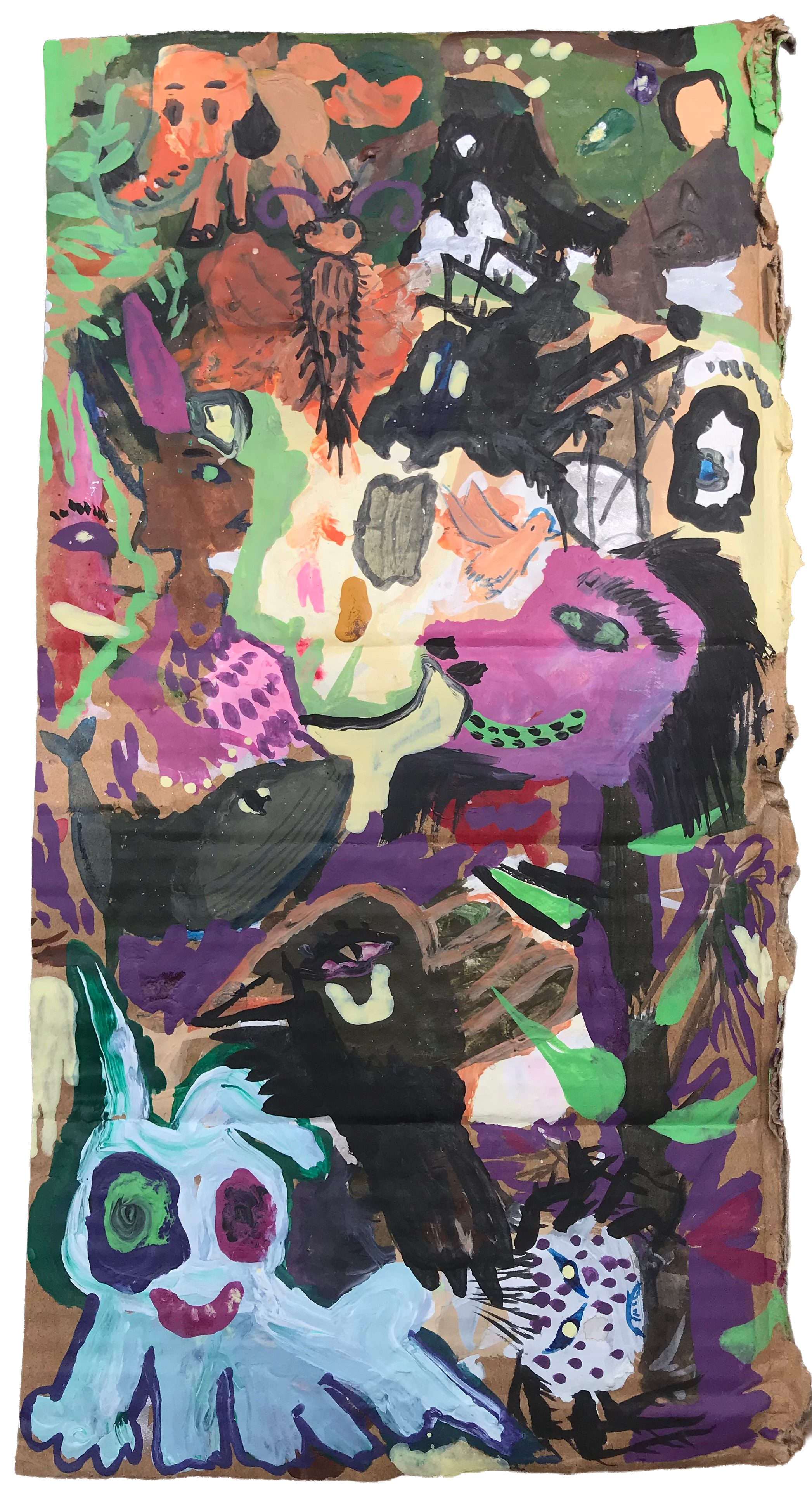
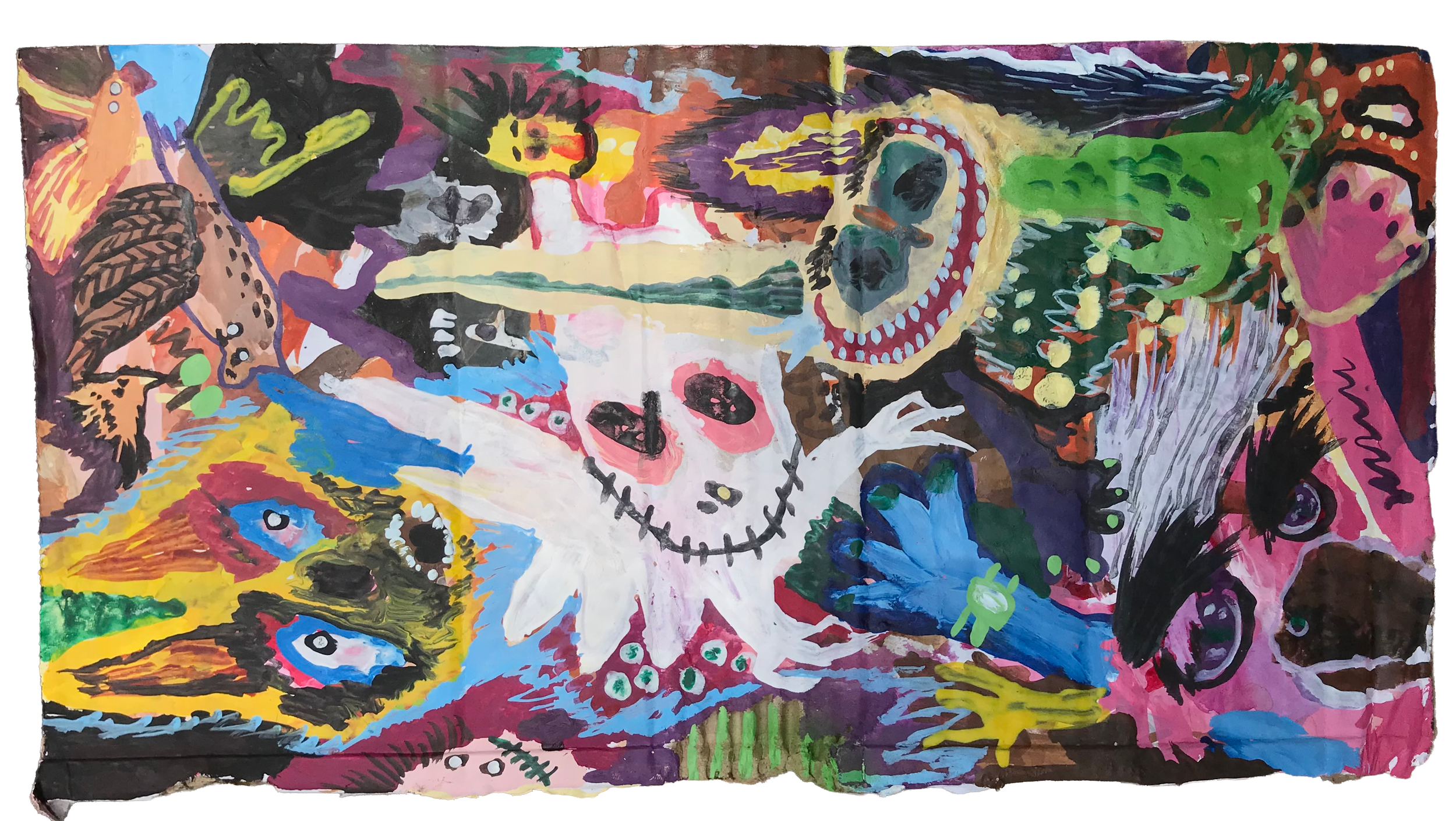
Umar Sharif
Comb-lumbarium I
2026
Ready-made dollhouse, used hairbrushes, polypropylene fibres (white)
59 × 58 × 22 cm